
When I say I’ve been to Angkor Wat, people sometimes reply, “where?” but when I show them this photo, they nod in recognition:

Angkor Wat at sunrise
Oh yeah, that place. The giant temple thing in Cambodia. In fact, Angkor Wat is the largest single religious monument in the world. (I guess that’s under dispute by Those Who Measure Religious Monuments or something, because most of the info I can find on it won’t give me a hard yes or no on the topic. Regardless, it’s huge–the outer wall runs over 2 miles long.) Of course it’s big, when you learn that “angkor” roughly translates to “city” and of course we know “wat” is fairly synonymous with “temple.” Angkor Wat is a temple and also a city.

Angkor Wat
Khmer king Suryavarman II built Angkor Wat in the beginning of the 12th century. He broke from tradition by dedicating it to Vishnu rather than Shiva, and orienting the temple complex to the west, rather than the east. In the next century, the main religion of the Khmers changed from Hinduism to Buddhism, so the religion associated with the temple changed, too. One of the main statues of the temple, which was somehow not destroyed during the reign of the Khmer Rouge (as most of the statuary was), is an eight-armed Vishnu whose head has been swapped out for a buddha’s head.

Vishnu/Buddha
Other decorations, however, are not so easily changed from one religion to another. Angkor Wat is impressive not just for its size and age, but for the bas-relief friezes that run around a large part of one of the inner walls. These friezes show scenes from the Ramayana and the Mahabharata, two Hindu epics. Many of the friezes have been restored by various conservation groups over the past few decades, and I’m so glad I got to see this artwork dusted off and cleaned up. It’s much easier to appreciate the incredible detail of each carving when the accumulated grime of centuries has been swept away.

The Churning of the Ocean of Milk
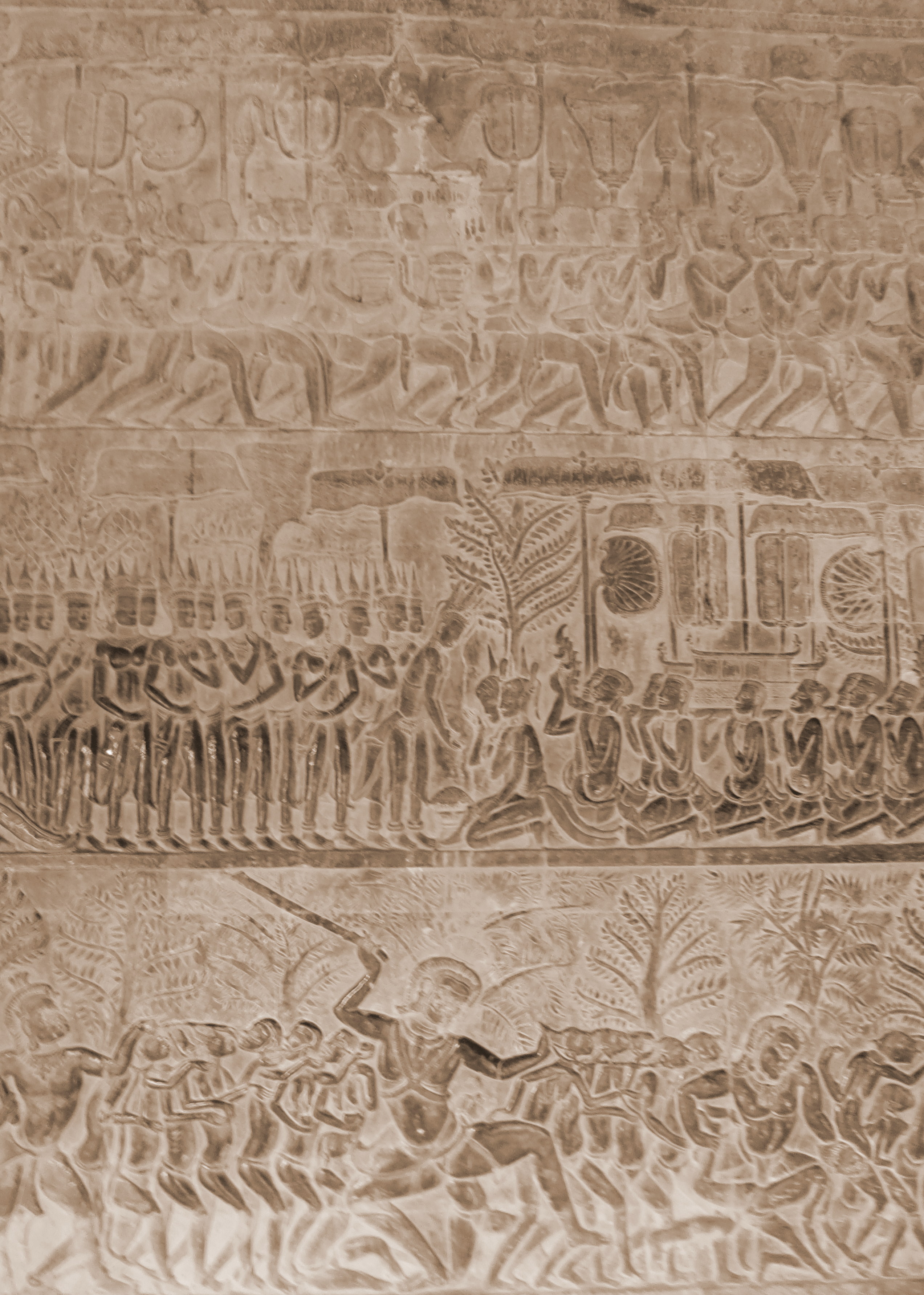
Bas-relief frieze
Angkor Wat is built in the temple mountain style: it’s meant to resemble Mount Meru, the home of the gods in Hindu mythology. There are always outer walls representing mountains, and usually a moat to represent the ocean. The inner temple is made up of five pyramids representing the five peaks of Mount Meru–usually four in the corners, and an elevated one in the center, the innermost sanctum of the gods.
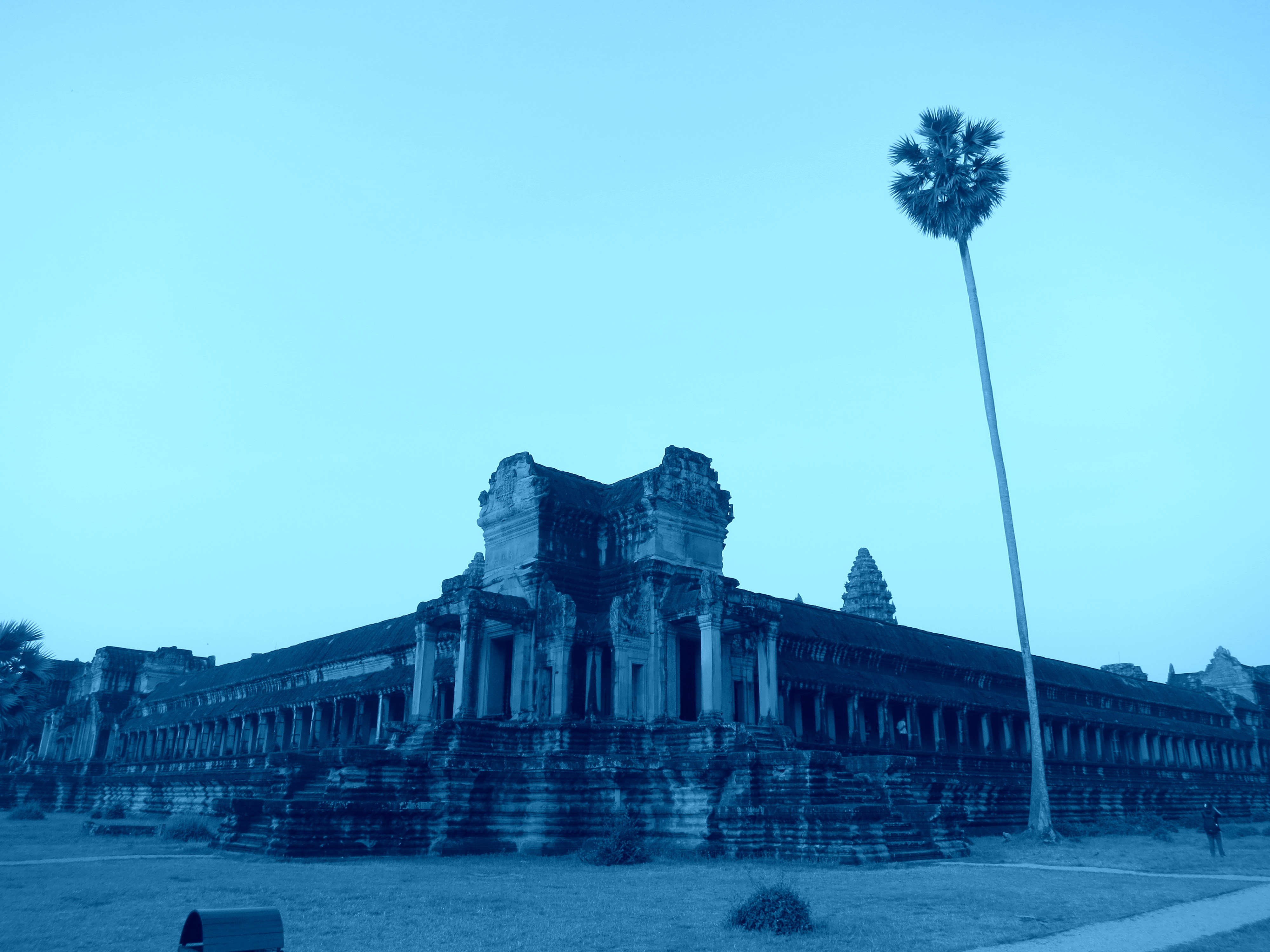
One of the distinctive features of Khmer architecture, according to my architecture guidebook, was the “trick of perspective” achieved by progressively reducing the height of each structure from the center outwards, making the central towers appear even taller and more impressive. This architectural trick expresses the religious beliefs of its builders, too, since it emphasizes the importance of the home of the gods and the humility of the rest of creation in comparison to it–even the oceans are reduced to flat moats calmly reflecting Mount Meru’s glory back to it.

For those of us who haven’t made a study of Khmer architecture or Angkor period temples (and that’s most of us, isn’t it), it’s good to keep in mind that a Khmer temple “was not a meeting place for the faithful but the palace of a god,” as Michael Freeman and Claude Jacques note in Ancient Angkor. Thus, the tiny space in the interior of the central pyramid, made only to house the statue of the god and not for crowds of worshipers; the super steep stairs that were usually only scaled by a few temple workers; and small buildings housing various gods, the grouping of which made up one large temple, rather than one temple per god. This is such a different approach to religious architecture from the Western, Christian one that I hadn’t even realized I had been making assumptions about what a temple was for and how that affected the architecture until this book pointed it out.

I’m used to vast cathedrals built to house masses of congregants; the altar is often large and ostentatiously decorated, and it’s easy to see from just about anywhere in the building. The temple mountain structure of the Khmer Hindu places of worship also accommodates large crowds, but in the outer areas of the grounds; the inner areas are difficult to reach, and the sacred space is small and hidden from the casual eye. I love that the book made me look at the temple in a different way, and also had me reflect anew on the churches I’d been to before.

None of the buildings from the city surrounding the temple (the “angkor” part of “Angkor Wat”) have survived. They were likely made from wood, unlike the sandstone, brick, and laterite of the temples. This means that a lot of imagination is required to envision what it must have looked like in its heyday, a little harder than putting paint on the Forum in Rome, but not as difficult as seeing the cooking fires smoking at the side of Uluru. I stood on the east end of one of the interior walls of the temple and looked out over the forest that stretched to the moat nearly two miles away. All this forest was once royal palace, regular houses, streets, food stalls, markets–all populated with one of the largest concentrations of humanity in the pre-industrial age.
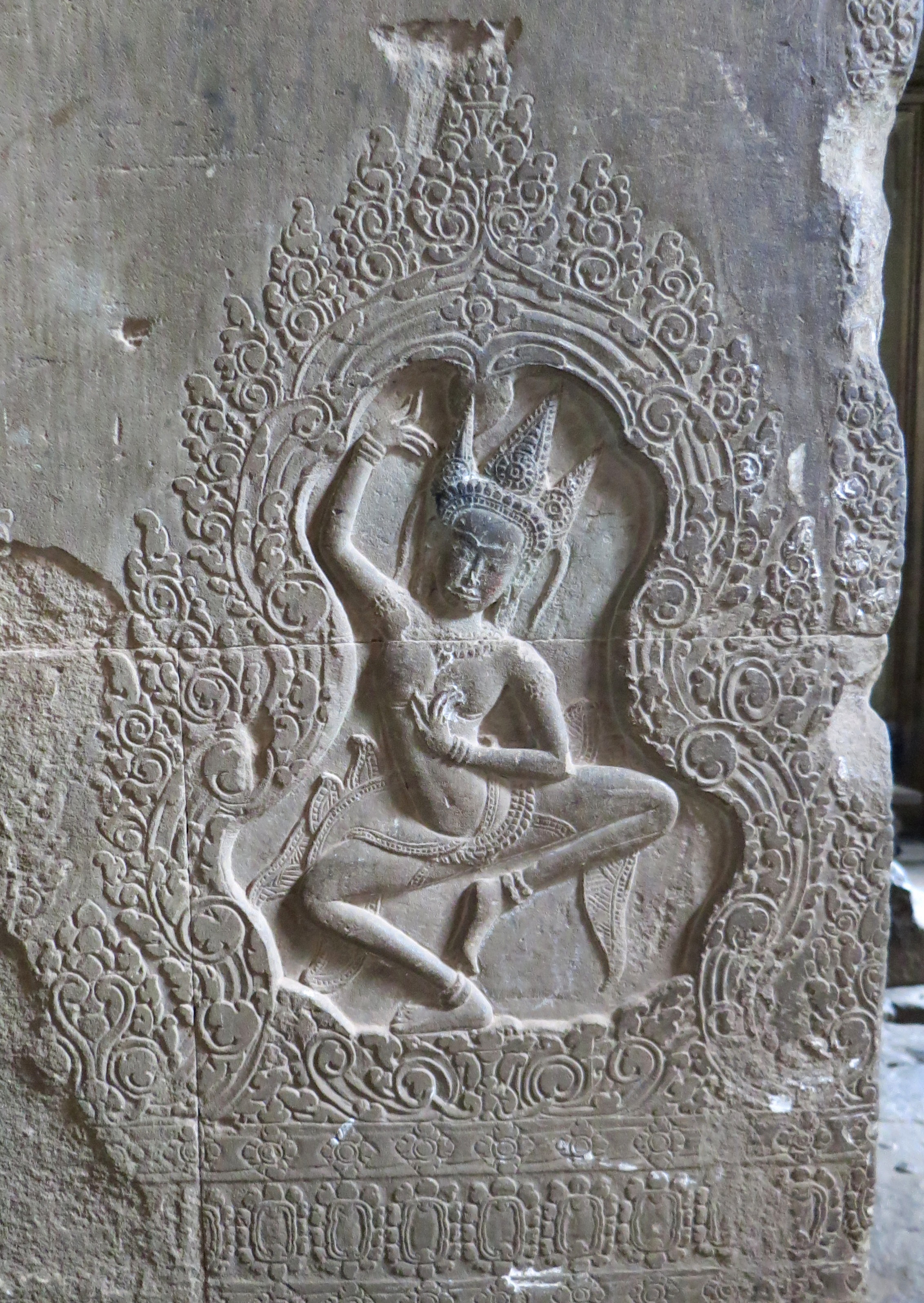
Aspara
This is all about Angkor Wat, but let’s not forget that the Angkor period lasted several hundred years, and almost every king built at least one temple (perhaps as a mausoleum for himself, the god-king), so there are nearly a thousand temples in the area. Dozens of these have been restored and opened to the public. It all seems an embarrassment of riches once you see Angkor Wat. Not only is there this magnificent complex, but there are more–and in different styles, with their own delightful carvings and architectural quirks? I enjoyed discovering those temples as well; stay tuned this week for more on those.

Embracing the sunrise


 Stowaway Travel Writing & Editorial Services