Reproductive Rights Under Attack: Give Five Minutes Now, or They’ll Take Us Back 40 Years

All right, dearest fellow travelers, let’s get real political. There are now bills actually under consideration in these United States that explicitly call for women to die, and the worst part is we as a country aren’t even paying attention. “Stop exaggerating, Lisa,” you may be thinking, but check out HR 3, the “No Taxpayer Funding for Abortion Act,” the purpose of which is to codify the Hyde Amendment and make abortion access virtually impossible for poor women, or HR 358, the “Protect Life Act,” which intends to establish so-called “conscience clauses” in the case of abortions that would save the woman’s life. [By the way, if you are already convinced about this topic, skip to the end, where I list easy steps you can take to make your voice heard. As the blog post title says, you can afford those five minutes, because we can’t afford to go back 40 years.]

Click here for resources on how to fight this bill

You may have read about an earlier version of HR 3, which sought to redefine rape to mean only “forcible rape,” as opposed to statutory rape, rape of incapacitated or mentally handicapped people, incest, or date rape. So basically, the last forty years of feminists educating people about the many different and terrible ways men can force themselves upon women and other men without physically holding them down or threatening them with a weapon — those years of work were going to be swept aside and rapists, who already hold too much power over their victims, would now hold all of it. Thanks in large part to pressure from groups like the Feminist Majority, NOW, NARAL, and Planned Parenthood, as well as the Twitter campaign #DearJohn, spearheaded by Sady Doyle and aimed at telling House Speaker John Boehner just how reprehensible the bill is, the forcible rape clause has been removed.

But sliding in right behind it is HR 358, which explicitly states that if a woman goes to a hospital in a life-threatening situation, and she requires an abortion to save her life, she can be turned away in order to salve the doctor’s conscience. Yes, you read that right: If a doctor decides that he is “pro-life” and it is against his belief system to perform an abortion and therefore end the life of a fetus, he can refuse to perform that abortion, even if that means that the woman carrying that fetus dies. Life-threatening situations aren’t exactly known for allowing a lot of time to find a different hospital with doctors who will perform the operation, and if you’re in a small town with only one hospital, you are out of luck. You are literally DEAD because the government has legislated your death.

How is this not front-page news? How are only progressive bloggers (and let’s face it, almost all of them women, at that) and left-wing websites the ones reporting on this clause? American women, wake up! Your government wants you dead. One hundred and twenty-one congressmen have co-sponsored HR 358. One hundred and twenty-one people in positions of power have outright said that your life does not matter. The best part is that it’s not as if the fetus is going to survive anyway, in these situations. So rather than save one life and unfortunately lose another, these people are encouraging doctors to step back and watch both woman and fetus (mother and child) die.

I know that abortion is an uncomfortable topic. Many women tell me they could never have one, and that’s okay. You have that choice. But it takes more than just telling other women they can have an abortion if they need to in order to truly be pro-choice; we need to support women in all of their reproductive choices, not just look embarrassed and turn the other way and say “oh Roe will take care of that.” Because the truth is that Roe is being chipped away into nothingness, and in its place we have ever more stringent laws put in place by lobbyists and legislators who take advantage of the fact that abortion is an uncomfortable topic.

If I want to have a baby, let me have a baby. If I don’t want to have a baby, don’t make me have a baby. Don’t hem and haw and hedge about which conditions are acceptable and which ones aren’t, or which women should have easier access to what they do with their own bodies. Don’t tell me it’s more complicated than that. It isn’t. I will do what I like with my body, and you will do what you like with yours. Too bad that you don’t like that I have multiple sex partners, but your religious beliefs about what that means for the state of my soul have nothing to do with me, and to force those beliefs on me in the form of law goes against American principles of liberty and independence, not to mention basic morals and decency. I may not like what you do with your body, and you may not like what I do with mine, but that is irrelevant. You’d think small government advocates, of all people, would be able to understand that.

A special note for my male readers: I get that abortion is a topic that makes you especially uncomfortable. It’s much easier to talk about revolutions and the politics of war and unions, since those are all things you can be a part of, whereas pregnancy is not something you are ever going to personally experience. If you’re a progressive man, chances are you’re pro-choice in the same general way that you’re pro-gay rights and pro-environment, but you don’t much go beyond that. Maybe you feel like you have nothing to add, since you aren’t a woman. Don’t take that easy cop-out! It is vital that we have male allies who take it as a matter of course that all women have legal, safe access to this medical procedure. Not to mention legal, safe access to the contraceptives that can prevent such procedures in the first place — as half of the equation that causes unplanned pregnancies, you’d better be campaigning for easier access to birth control (ahemover-the-counterECahem). Don’t kid yourself that women can be part of your labor movement, your environmental movement, your revolutionary movement if they don’t have access to reproductive health services. They can’t be there for you if you won’t be there for them. It’s in your own interest, if that’s the final push you need to get fully involved in this issue.

And if you’re not a man who is generally involved in political issues, well then, there’s this old chestnut: What if it were your sister/daughter/friend/wife/mother? Statistically, you know someone who has had an abortion. Statistically, you know someone who has been raped. Act according to how that makes you feel, according to how you want those women in your life to be treated.

I have followed the Egyptian revolution closely these past few weeks, and I have cheered for the Egyptian people as they have brought about democracy with perseverance, eloquence, and a unified will. Don’t think for a moment I don’t think their fight is important. But let’s bring our attention into a wider focus. Our domestic situation is dire, and we need our own perseverance, eloquence, and unified will to reveal the “culture of life” for what it is — a death sentence for American women.

TAKE ACTION!
I know we are all busy and have a lot to do in any given day, but this will take literally five minutes of your life, and as I said in the title of this post, they are forcing us back to days that are, frankly, unimaginable to me and most people of my generation. Give Five Minutes Now, or They’ll Take Us Back 40 Years.

Okay, so a thousand-word tirade has convinced you and you’re fired up. Now what? You know I wouldn’t leave you hangin’, baby. Here are some very simple steps you can take:

1) Write to your representatives. Everybody! If your rep is a co-sponsor of either of these bills, definitely write to them and voice your vehement disagreement. They need to know that a loud part of their constituency does not support their actions. If your rep is a strong pro-choicer, write to them and ask them to be loud in their opposition to the bill, rather than staying quiet on it. We need loud champions in the House and the Senate both. If your rep is somewhere in-between, write to them to urge them to vote against this and all anti-choice legislation.

2) Sign a few petitions opposing the bills. Twitter away about this with the #DearJohn hashtag to raise awareness; don’t let it all slip away under cover of the health care bill, the economic wrangling, or international events.

3) Get out there and march, old-school style! Walk for Choice 2011 is going on in cities all across the country (and even overseas in some places). On Saturday, February 26th, have a hearty brunch, then meet up for a noon walk to bring visibility to this issue in your hometown.

4) Write to your newspaper. Sure, this is about as old-fashioned as it gets, but the fact is that a lot of people still read the newspaper rather than the Internet to get their news, and a lot of voters read that Letters to the Editor section. Get their attention! Something like this: “The current attack on women’s lives in the US Congress is reprehensible and un-American. Rep. Christopher Smith’s (R-NJ) proposed legislation, HR 3, would make permanent a law that prevents women from using Medicare to obtain abortions except in cases of rape, incest, or when their own lives are in danger. This bill clearly affects poor and uninsured women the most, and its passage into law would put an even greater burden on them when they are at their most vulnerable. The bill’s addendum, HR 358, goes even farther in devaluing women. It allows doctors to refuse to treat a dying woman if doing so would mean performing an abortion. We cannot allow the government to legislate the deaths of thousands of American women every year. Both bills are an attack on the American values of liberty, independence, and a dignified life. Our legislators must reject this legislation and introduce stronger protections for women’s health and their lives.”

5) Donate money to organizations that work full-time to ensure women, men, and children have safe access to reproductive health services no matter their income level. Title X organizations like Planned Parenthood are also under attack right now under a different bill, so they can especially use your precious dollars right now.

Here is a fantastic, comprehensive list of resources (scroll down a bit), including ways to donate money, scripts for talking to your congressperson, and how to sign various petitions.

FURTHER READING:

Fighting to survive: HR3, HR358 and the war on womens’ health by Sady Doyle (on how co-sponsors of these bills are literally killing their base, which seems a foolish move)

Denounce Republicans? When there are Democrats co-sponsoring HR 3? by Shannon Drury (drawing attention to the hypocrisy of the DCCC in this situation)

Meet the HR3 Ten: Heath Shuler by Sarah Jaffe (introducing us to the Blue Dog Democrats who co-sponsor these bills)

The House GOP’s Plan to Redefine Rape by Nick Baumann (one of the original articles on the issue)

Abortion does not harm mental health, study says by Alicia Chang (so there goes that argument — spoiler: this is not the first study that has proven this, and not a single study has proven the opposite)

Chipping Away at Roe… and the Definition of Rape by Melissa McEwan (on how this gives rapists a road map on how to avoid conviction)

I used to be a pro-life Republican by Andrea Grimes (on how realizing that abortion could affect her personally changed her views radically)

What Would Shirley Do? by Linda Greenhouse (on Shirley Chisholm’s work to debunk the myth that abortion is “racial genocide”)

Nancy Pelosi brings it: “We have to make this issue too hot to handle.” by Maya (blog handle) (kudos to House Minority Leader Pelosi and Senator Kirsten Gillibrand for starting http://www.stophr3.com/ and acknowledging that this is a serious fight that needs serious fighters)

Anti-Abortion Bills Surging Through Capitol Hill–and States, Too by Miriam Zoila Perez (keep an eye on your state’s legislature, too — denying women their right to choose isn’t just for Nebraska anymore)

The Anti-Choice Suffering Agenda by Thomas Macaulay Millar (if personal anecdotes don’t do it for you, this simple, logical breakdown of how all these laws are clearly about punishing women and not about saving babies will)

House Republican Spending Cuts Target Programs for Children and Pregnant Women by Pat Garofalo (once you are forced to have that baby, don’t expect any support to raise the child)

On Labor by Ta-Nehisi Coates (a heartbreaking story about just how real maternal death is and how fundamentally unfair it is to require women to undertake that risk if they don’t want to)

And finally, a bit of fun:

Felicity Huffman and William H. Macy sing a ditty from the perspective of a good, conservative woman — who still wants the government out of her underwear. Highly enjoyable!

AND MOST FINALLY:

If you’ve read this far, I hope you’re convinced that your action is needed on this issue. I encourage you to leave a comment saying what action you’ve taken, so that we can build a visible record of involved citizens. It’s so easy to say, “Well, other people are working on that,” but I think if we say it right here, we can see just how vital our own voice is in the struggle for human rights, and how simple it is to raise that voice.

Thanks for reading.

The Good, The Bad, and The Silly

The Good:

That’s right, Alaska, you use conservatives’ logic (and word choice) against them in the abortion debate! (Too bad it didn’t work and the damn parental notification law got passed anyway, but still. This is a thought for future fights.)

“Step Up. Step Back.” — the way for men to be feminist allies. (And also whites to be anti-racist allies, straights to be LGBT allies, etc.) (Via.)

The Bad:

Farmworkers are denied basic human rights, such as one day off a week, in New York and California. (Via.)

Bloomberg’s staff deliberately misconstrues the Seneca Indian Nation’s protest of his offensive shoot-em-up comments; whether the cigarettes should be taxed or not is not the issue when a high-profile government official states that another US government official should “get a shotgun” and say “the law of the land is this, and we’re going to enforce the law” to a tribe of people who have been at the wrong end of a shotgun courtesy of the US government too many times to count over hundreds of years. (Via.)

The Silly:

Possibly you’ve already seen this, but somebody decided to make a trailer for a fake movie — and I want to see the full-length. Jane Austen’s Fight Club! (Thanks to Sessily for the link.)

What have you seen/heard/read this week?

UPDATE: I just read this excellent piece by Timothy Egan, which breaks apart who is spreading what lies about Obama and why it matters. Wake the hell up, America; you’re better than this.

The Good, The Bad, and The Silly

Hello dearest fellow travelers. Here’s something new! I thought I’d start a feature that rounds up some of the best and worst of the political/cultural news I run across each week, so you can get even further inside my brain without getting too Malkovich about it. And since usually the good and bad news is still news and therefore always kind of a downer, how about a silly element on the end of it? Something lighthearted, cheerful, adorable, or otherwise Unserious. If you’re already reading blogs with a political or cultural slant, probably you’re running into similar features, and maybe you won’t find much new here. But maybe you will, and then you will feel enlightened. Also, you can put links to other interesting articles in the comments and this blog will become a veritable font of information.

So here we go — the inaugural The Good, The Bad, and The Silly!

The Good

“Papers, Please” portion of AZ law SB1070 put on hold by federal judge — it’s a start

Erin Andrews urges Congress to pass a stricter anti-stalking law, one that would include high-tech types of stalking and emotional threats

The Bad

As is so often the case, human rights are traded for money — prisons are set to profit big time off SB1070

As the Kalamazoo area reels from an oil spill, Democrats decide a majority in both houses and the White House, plus an oil spill disaster in the Gulf that has the country fuming, isn’t enough to actually push through tough energy reform (Via)

Also, check out this site and be sure to place it over your city. It’s truly disturbing. http://www.ifitwasmyhome.com/

The Silly

A mother makes fantastical dreamscapes starring her baby (Via)

What have you run across?

Arizona’s New Era of Racism: The Ethics of Traveling to Repressive Places

The state of Arizona recently passed SB 1070, which is a terrifying piece of legislation that mandates racial profiling, rewards paranoia and hate, and puts Arizona back at least 50 years. This is no exaggeration. Take a look at that NYT article — this law REQUIRES police officers to demand identification papers from anyone they suspect might be in the country illegally; it makes it a misdemeanor to not carry immigration papers; and it lets any citizen sue local law enforcement if they think this law isn’t being enforced. First we have Driving While Black; now we have Living While Brown.

This is the only law of its kind in the United States, but don’t think that doesn’t mean other states aren’t running to catch up. And don’t think for a second it isn’t racist. Check out Rachel Maddow’s short but effective rundown of the authors of the bill — longstanding members of groups whose explicit purpose is to make sure America’s majority is white. Who are most of the undocumented immigrants in Arizona? Latinos. So a law aimed at cracking down on illegal immigration is aimed at cracking down on Latinos. And how do you determine which Latinos are US citizens, legal immigrants, tourists, etc. and which are crossing the border from Mexico without official approval? No really, how do you tell? Even Governor Jan Brewer, who signed the bill into law, couldn’t answer that question. “I do not know what an illegal immigrant looks like,” she said when asked. But the police are supposed to know and make arrests based on that unknowable qualification? Is this like porn — I know it when I see it? Nope, pretty sure it’s like mandatory racial profiling — all brown people are immediately suspect.

handmade sign at the May Day rally

no child should know what a SWAT truck looks like

My dad is always concerned that I consider the other side of the matter before taking a stand, which is good advice. So okay, people who support this bill are concerned about what, exactly? Sharing increasingly scarce resources with people who weren’t born here? Talk to your representatives about spreading the wealth a little more evenly. Losing your job to someone who braved brutal conditions, rape and murder on the trip from Mexico to the States? Even fairly conservative groups will agree that many undocumented immigrants do the work you don’t want to do, and in some cases their presence even raises wages. The increasing rate of crime in your state? Take a look at those who say they’re protecting the American way and then talk to me about rising crime rates. But mostly the support for this bill comes from many white Arizonans’ discomfort at the many brown faces they encounter on a daily basis. I hate to break it to you, but you weren’t exactly here first, and you were never really the majority.

I think the reasoning that most kindhearted but ignorant Americans hold is that it’s already illegal for these people to be here, so what’s the big deal if they get caught? Well, a whole lot of people who have every legal right to be here are going to be caught up in this giant net that’s been cast, simply based on the way they look. What if they run a red light, as anyone is liable to do, and they forgot their immigration papers at home? White Arizonans would be ticketed for running the red light and sent on their way. Latino Arizonans will be ticketed, handcuffed, and brought to the police station for holding and questioning while they’re run through the system to see if they’re allowed to be here. Everyday lives will be dramatically circumscribed, as every action is weighed against the possible consequences from a hostile law enforcement body. And that’s just legal immigrants and citizens.

Undocumented immigrants (“illegal immigrants” confers illegality on a person’s very being and thus dehumanizes them, and anyway is less accurate than “undocumented immigrants,” so I won’t use it) face grave consequences for simply being out on the street when a police officer happens along and decides to take a closer look at them. The category of “undocumented immigrants” encompasses a whole host of people, including people who were brought here by their parents when they were young and know no other home than the States, people who are escaping brutal regimes and couldn’t gain refugee status but are still terrified to return to their homeland, and women who are escaping the more commonplace but equally terrifying regimes of their brutal partners. “Undocumented immigrants” does not equal “job-stealing criminals.” It equals “people.” It equals “you or me in a different situation, in a different stroke of luck or fate.” The consequences for undocumented immigrants under this law is families being ripped apart, wretched treatment in detainment facilities, forced deportation, and uncertain and dangerous futures. That’s the big deal if they get caught.

This law is not “misguided,” as President Obama has called it. It is hateful and wrong.

May Day Rally at Daley Plaza 2010

May Day Workers' Rights and Immigration Reform Rally at Daley Plaza 2010

So what do we do about it? This roundup at Feministe has some suggestions. The May Day rally I attended in Daley Plaza certainly united people in a loud, strong voice against it. Even some law enforcement officials are outright refusing to obey the law. Write to your Congressperson and Senators; encourage them to work on strong immigration reform legislation in this next congressional session. Write to President Obama and tell him “okay job on health care, we’ll see if Wall Street reform works, now let’s get to immigration reform.”

And since this is a travel blog, as my friend Pam suggested, let’s consider the travel implications. It might seem a small thing, but I do believe every stand we take matters. Representative Grijalva has called for a convention boycott of his own state in protest of the law, and the city of San Francisco has already voiced its support. I’m just one traveler, but I can keep my money away from Arizona and its repressive ways. This isn’t even the only racist law they’ve instated recently — ethnic studies courses are now banned as treasonous, and the state Department of Education is removing teachers who speak with too thick a Spanish accent (even though a study shows that accented teachers might be better for their students). This is a state intent on enforcing a very narrow definition of “normal” and “acceptable,” and it is a state that needs to be stopped. Whatever we can do to turn back this tide of racism, xenophobia, and hatred, we must do. Of course, there are many people in Arizona and out of state who have worked tirelessly for years for human rights in Arizona, and there was a big push from a lot of groups prior to the signing of this law to stop it before it got to the governor’s desk. Unfortunately, their calls for reason and basic decency went unanswered in this case, but that doesn’t mean that’s the only answer they’ll ever get. Americans are scared, and scared people often do stupid things. We must help people see that fear is not the right way to live, or the right way to vote.

And that’s where travel boycotts come in. Pam asked me to consider the ethics of traveling to repressive places, and what I’ve come up with is this: There are varying degrees of repression in every single human-occupied place on this planet, so of course I can’t avoid them all, nor would it be right to do so. But I can refuse to support local economies with my money and my high praise if I find their laws reprehensible. This is a work in progress kind of rule, but I think it comes down to agency and power (as so much does). The residents of Burma, for example, have agency, as every human being does, but they have very little real power, because the ruling junta has it all. The brutal laws of Burma are terrible, but I might still visit there to aid locals (if they wanted me — not all foreigners are welcome, since Americans especially can cause more trouble than they’re worth there). A boycott of Burma might hurt the residents more than the state, and the residents haven’t yet been able to oust their repressive government in favor of another.

The residents of Arizona, on the other hand, have agency AND power. They have the power to nominate and elect legislators who will pass just laws and protect the interests of ALL residents, documented and undocumented alike. Instead, an unfortunate majority of Arizonans has elected cowards, racists, and calculating fearmongers to lead them, and so we get laws like SB 1070. I will not visit a state that elects such people. I will not give money to citizens who support such legislation. This is rough for the many, many Arizonans who work so tirelessly for equality and justice, but I think it is an important statement to make against those who work for the degradation of fellow humans. Arizonans have the power to change their government, their laws, and their way of life, and so I will hold them responsible for doing just that. I have a very good friend in Tucson, but I don’t think I can visit her until her fellow residents have worked out some of their problems. People are rightfully quoting the “First they came for…” poem, but as Problem Chylde says in a brilliant and impassioned post, “We no longer wait for them to come. First we fight.”

What do you think? What is the ethical approach to visiting repressive states? What is the right response as a traveler to unjust laws and fear-filled populations?

May Day Rally 2010

Rallying for change and hope

P.S. I know I’ve used the word “racist” a lot in this post, and I know that makes a lot of people uncomfortable. Generally I agree with Jay Smooth when he says that you need to address the action rather than the sentiment behind it, but sometimes you have to call a racist a fucking racist.

Pretty Awesome Scoundrels

I recently watched a movie about a smart, lying, double-crossing, two-faced woman, and she was not called a bitch. This is such an incredible thing that it merits its own post.

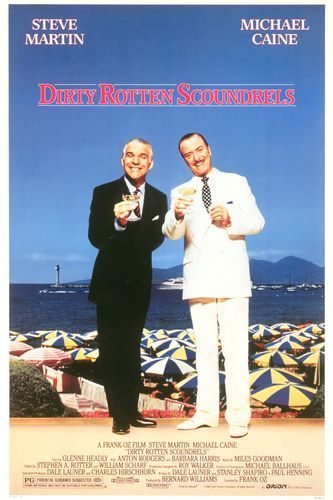
The movie is Dirty Rotten Scoundrels, a Michael Caine/Steve Martin vehicle that plays to each of their strengths perfectly. Michael Caine gets to be a genteel know-it-all, and Steve Martin gets to be an obnoxious loudmouth. They are both con men, although Caine works only among the upper crust and does very well for himself, whereas Martin considers himself well off when he cons a woman out of twenty bucks. The entire movie consists of Caine trying to get Martin out of his small French Riviera town, so he can go back to working it by himself, conning rich women out of their jewels and pocketbooks by pretending to be a prince in need of funds to battle communists in his home country. Hilarity ensues. (No, really, it’s very funny.) The main plot unfolds when they bet that the first one to get $50,000 out of Glenne Headly, an American heiress, wins the rights to stay in Beaumont-sur-Mer, and the loser leaves town.

Dirty Rotten Scoundrels

Hide your valuables, ladies, the charm offensive is on

*SPOILER ALERT* The problem is, the heiress turns out not to be an heiress, but rather a woman who is touring Europe as the winner of a contest for a detergent company. She’s promised both men the $50,000, but has to bankrupt herself in order to get it. Caine turns out to have scruples and calls off the bet. Martin, unsurprisingly, has no scruples and wants to continue the bet, or at least amend it — the first man to bed her wins. Caine shows even more character when he says that he won’t try to woo her himself, but he’ll bet against Martin’s success. *NO REALLY, THIS IS THE FINAL TWIST OF THE FILM* Headly declares herself in love with Martin, and visits his bedroom. Caine hears of this and is ready to admit defeat, but then Headly shows up at his house, crying that Martin took her $50,000 and she has nothing now. Caine gives her $50,000 of his own money and takes her to the airport, where she thrusts the bag of his money back in his hands, declaring she can’t take it and running onto the plane. Only then does Martin appear, screaming that Headly took HIS money, and when Caine opens the bag, he finds instead a note from Headly that reveals she knew their con all along and played them the whole time.

Martin’s reaction: “Of all the lousy… She is disgusting! She is lying, deceitful, two-faced. She is conniving and she is dishonest!” Caine’s response: “Yes. Isn’t she wonderful?”

Now, in just about any other Hollywood film from the last fifty years, Martin’s reaction would’ve included “That bitch!” in there somewhere — we’d need to know that she is not just another player in the game, but that her gender makes her a particularly despicable one. She would not be a worthy opponent with individual skills to assess and combat, but a generic enemy in need of crushing. We would have had lingering shots of her legs and chest throughout the film. We probably would’ve seen her get naked in preparation for sleeping with Martin.

Not only that, but the other women Caine and Martin con would be bimbos, sluts, easy marks not just for being rich and stupid but for being rich and stupid in a gendered way. Instead, they are easy marks because, in Caine’s words, they’re “screened. They’re wealthy and corrupt.” His scams always involve women, yes, and they hinge on the need of these particular women for flattery, romance, and a distraction from the stultifying boredom of extreme wealth. But the scams don’t involve sexual humiliation, or dick-waving bragging afterward, or even stripping the women of all their material wealth. Caine takes a large amount of money, possibly after a mutually satisfying sexual liaison, and then slips away. And when things go badly, say, for example, when he is robbed of $50,000, he does not blame the woman who played him, or call her a bitch for outsmarting him, or plot revenge. No, he calls her wonderful, seeing her as an equal, a great challenger to his title as master con artist of the Riviera.

The movie even ends with Martin put firmly in place. Unlike Caine, he did try to degrade Headly by betting on his ability to conquer her sexually. The I-bet-I-can-screw-her-oh-wait-now-I-love-her-so-I-will-be-honorable-and-at-the-last-minute-not-continue-in-my-lie-and-take-her-clothes-off-but-it’s-cool-because-that-one-moment-of-restraint-is-enough-to-convince-her-of-my-love-so-she’ll-totally-screw-me-later-so-the-moral-of-the-story-is-I-get-laid-either-way trope is so tired, and it was refreshing to see it turned inside out here. Not only does Martin not get with Headly, and not only does she not fall in love with him, but she steals his money and leaves him naked in a hotel room. And at the end of the film, when she returns to the two men to pull them into working a con with her, she introduces Caine by name and has him talk as an integral part of the con, but then introduces Martin — “he’s a mute.” Caine was going to dupe her out of her money but not her dignity. Martin was going for whatever he could get, and what he got was shut the hell up. Fantastic.

The remarkable thing about Headly’s deception is that the movie is clear that she does this not because all women are evil, or cold-hearted, or only in it for the money, but because she is the same creature as these men, a brilliant liar who lives for the con. I don’t know how you feel about movies based on crooks swindling hard-earned money out of honest folks, but I love them. Con movies — Trouble in Paradise, The Sting, etc. — are delightful works of sparkling wit, fine-tuned plot, and great reaction shots. Morals shmorals, give me Paul Newman’s nose-scratching signal any day. This is one of the few films I know of that is so devoted to the wonder of the con that it lets women play too. And that’s pretty awesome.

I Propose We Revamp the True Romantic Comedy: An Evisceration of “The Proposal”

Dearest fellow travelers, in the words of Gob Bluth, I’ve made a huge mistake. Not quite on par with selling out my brother or denying parentage of my son, but still scarring — I watched The Proposal. It was a slow Wednesday night, it showed up in my Netflix On Demand queue, and I like Sandra Bullock, so I thought, “Why not?” OH MY GOODNESS, SO MANY REASONS WHY NOT.

I should have turned it off within the first three minutes, when it became apparent the movie is not grounded in any version of reality I’m aware of. Sandra Bullock’s character, Margaret, is the top editor at some fancy book publishing house. In the opening scenes, we follow her as she barrels through the streets of New York on her way to the office; she spends the whole walk arguing on her cell with one of her best-selling authors. The argument? She got him a slot on Oprah to talk about his book, and he doesn’t want to do it. JUMP BACK. There is no author in the history of ever who would pass up the opportunity to appear on Oprah’s show to promote their book. Austen wanted on Oprah. Dickens owes half his popularity to his delightful Oprah appearances. Poe never got an Oprah interview, and he ended up roaming the streets of Baltimore, raving mad and hours from death. The only author to have not gone on Oprah after originally offered a slot is Jonathan Franzen, and even that was a rejection of Oprah’s Book Club and not a TV appearance (she pulled the interview after he revealed he didn’t want the book club sticker because men might find it off-putting (which, ew, men, get it together)). Every writer, published or unpublished, believes that their book is just the right one to fit between a celebrity interview and a spa package giveaway on the Queen of Talk’s show. Every  newly signed author eagerly sits down with the publicist assigned to them and says, “I’ve got a great idea for publicity. I should go on Oprah!” The publicist then groans inwardly, because the percentage of authors who make it on Oprah is minuscule, and out of that, the percentage of new authors who get to sit in Harpo Studios is infinitesimal. So you’d better believe that when an editor finagles an Oprah appearance (and by the way, I bet the publicist is a little pissed at being shoved out of their job on this one), the only response she’s going to receive is hysterical screaming, tears of joy, and possibly the offer to name their firstborn after her. When one of the plot points of your movie centers around something so deeply misguided as an author refusing to appear on Oprah, you know your movie is already in serious trouble.

But I didn’t turn it off, much to the detriment of my psyche. Apparently, when The Proposal first came out in June, critics didn’t think the movie was anything to write home about, but they didn’t think it was the worst of the breed. Oh my word are they wrong. It’s heavy-handed where it should be lighthearted, mean-spirited where it should be heartwarming, and dull where it should be lively. Not to mention, it’s a feminist’s nightmare.

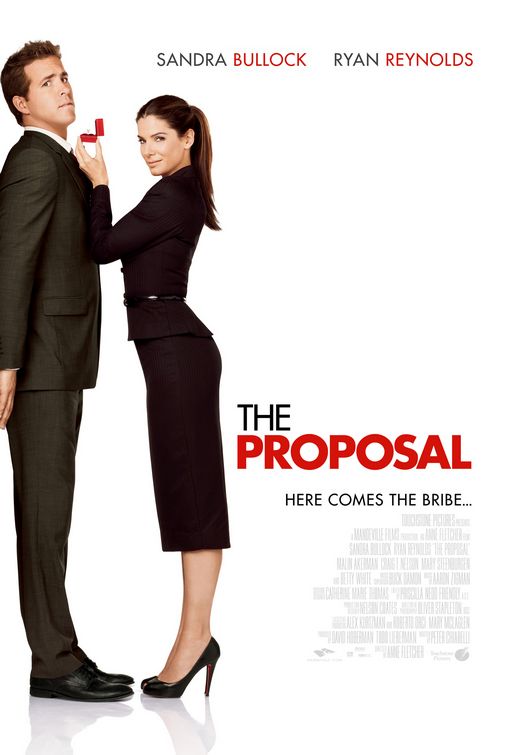
The Proposal poster

source of severe psychic damage

First, the form. I am a fan of romantic comedies; they are, at their best, vehicles for rapier wit, brilliantly timed physical humor, and genuine warmth between two likable leads gamely playing out gender politics and societal tensions on their way to the altar. It Happened One Night, The Philadelphia Story, Trouble in Paradise, Bringing Up Baby — all fantastic romantic comedies. Also all pre-WWII. Way back in 1999, Stephanie Zacharek at Salon wrote a great piece on what is wrong with the rom coms of the ’90s. Things haven’t improved since then. Think Valentine’s Day, Sex and the City, 27 Dresses, He’s Just Not That Into You — all films that seem to revel in women as catty, desperate, pathetic creatures, and men as clueless, boorish, and somehow just right for you. Many feminist sites comment regularly on the dearth of decent rom coms — Feministing even has a regular series about it, which I recommend. So I’m just joining these highly intelligent and perceptive women when I say romantic comedies ain’t what they used to be.

Generally, romantic comedies follow a predictable formula — boy and girl meet (ok, in Hollywood, heteronormative movies, it’s always boy and girl), boy and girl hate each other, boy and girl spend the rest of the movie figuring out that they love each other, usually with the help of some quirky friends. In the best ones, the obstacles are there for real character development, not just as haphazard roadblocks against the inevitable conclusion.

In The Proposal, however, the main obstacle is the slimmest of excuses — Margaret is a Canadian citizen who violated the terms of her visa and will be deported if she can’t come up with a legitimate reason she should stay in the country, so she pretends she and her assistant, Ryan Reynolds’ Andrew, are engaged. But they have to fool the evil USCIS agent who doesn’t believe their story! And they have to fly to Alaska to meet Andrew’s family and fool them into thinking it’s a real engagement, too! And Andrew has to learn how to be a man again! And Margaret needs to learn over and over and over again that what she really wants is the love of a good man!

Right. About that. Aside from the glaring publishing industry inaccuracies (throwing in a reference to the Frankfurt Book Fair does not make you up on your game, screenwriters), the movie’s main problem is its obsessive focus on taking the most extreme elements of Taming of the Shrew and applying them to the modern age. Margaret is a successful businesswoman, therefore she must be bitter, alone, and a total domineering bitch. We know this because the office underlings call her “it” (gee, that’s not unnecessarily dehumanizing), she doesn’t smile, and she fires someone when he doesn’t do his job. She must be stopped. Placing her in Alaska gives her lots of opportunities to learn the valuable lesson of humility — or rather, humiliation, which is not the same thing. Andrew grabs her ass on two different occasions, both in front of people; a stripper brings her onstage against her will to gyrate on top of her and stick his junk in her face, much to her discomfort; she takes a huge spill off a bike only to find herself in the middle of some faux-Native American spirit dance whose main purpose seems to be allowing Andrew to see her jump about and grunt so he can call her weird; she gets self-conscious around Andrew in the morning and puts on makeup in bed so he won’t notice what she actually looks like when she wakes up; he sticks his erection in her ass as they try to snuggle for the benefit of his family; she reveals secrets about herself in an attempt to bond with Andrew and show him her softer side, and he laughs at the fact that she hasn’t been laid in a year and a half; and finally, she falls out of a boat into the ocean, and flails about in panic because she can’t swim, and Andrew must save her. Literally save her. The gods of subtlety were not with these screenwriters.

In contrast, the only lesson Andrew seems to need to learn is to turn his sarcasm meter up to “high” every time he talks to Margaret and get into arguments with his father that he can stomp away from so he can do some good wood chopping (not a euphemism). We’re supposed to believe that he’s nothing but belittled by Margaret, and so not only does she have what’s coming to her, but he has to be the one to give it to her. And how is he belittled? He wakes up late (not her fault, as far as I can see) and  runs with two hot coffees and slams into the mail guy, who he then berates (not the mail guy’s fault, as far as I can see). She makes fun of him for ordering the same coffee as she does, tells him she won’t buy the manuscript he’s selected from the slush pile, and makes him accompany her to the firing of another editor. She does force him to be fake engaged to her so that she doesn’t get deported. Except, well, he could just not do that. She counter-argues that he has to because he needs this job and he won’t be able to move up in the publishing world if he doesn’t make her happy, but one of the main markers of publishing is that people change companies all the time. Even if it were another industry, I’m pretty sure he’d make it. So that’s it. Those are the many, many ways she emasculates him, and those are the moments he makes up for by continually mocking and molesting her throughout the film. I call foul.

One of the great hallmarks of terrific romantic comedies is that both main characters grow and become more suited for one another. It Happened One Night is another kind of Taming of the Shrew, and there’s some ass-slapping and “shut up”s that are a little jarring, but even those instances are part of both characters letting go of stereotypes and learning how to be kinder toward one another — and that was made in 1934, not 2009. In Bringing Up Baby, Katharine Hepburn’s character is a bit MPDG, with the key difference being that she actually has her own wants and needs. But those wants and needs, while pursued to ridiculous ends, aren’t portrayed as totally unreasonable or the province of an overly demanding or pathetically desperate woman. Rather, she’s a bubbly young woman who falls for Cary Grant (who wouldn’t?) and enacts several schemes to win his heart. This proves successful, and while he becomes a little more adventurous, she isn’t knocked down a peg or two. There’s no sense that she has to give up an essential part of herself to be worthy of love.

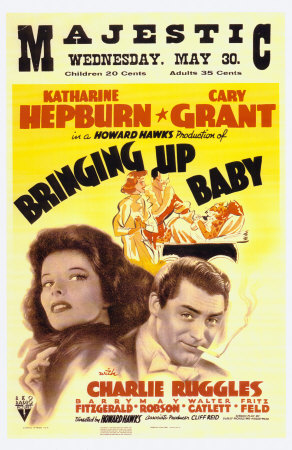
Bringing Up Baby poster

this is how it's done

In The Proposal, there wasn’t much to define Margaret’s character to begin with, but at least we knew that she was good at her job, appeared to enjoy it, and had built herself up after the devastating loss of both her parents when she was only a teenager. That all gets broken down as she is shown to be hopeless at the Internet (really? she didn’t recognize the sound of a modem connecting?), so her very competence is brought into question; scared of Andrew’s family’s dog, which makes her even more of a weak woman because it’s a tiny dog and who’s scared of those?; and ultimately sacrificing herself for the well-being of Andrew (which wouldn’t at all be a bad thing if he’d sacrificed anything for her, or if she’d learned a lesson other than “I’m not worth a family’s love and will go cry in Canada now”). She gives up every part of herself, he gives up no part of himself, and it’s supposed to be a happy ending. I’ve rarely been more depressed when a movie ended.

There was no chemistry between the leads, we had only Betty White to carry all the comedic relief, and the dialogue was wretched. The Proposal is a failure purely from a basic cinematic point of view. But its failure as a romantic comedy — and one directed and produced by women, no less — is what really upsets me. I think the term “feminist’s nightmare” might be a bit overused, but in this case, it’s true. The lessons we learn are thus: Women shouldn’t be in charge, women should find a man and settle down, men should be jerks to women if they want their respect and love, and we should pervert love so that this is all done in love’s name. Pretty nightmarish.

At the very end of the film, as Margaret and Andrew kiss in an office full of coworkers, someone yells out, “Show her who’s boss, Andrew!” As if we were in any danger of forgetting.

Flying the Fat Skies

Dearest fellow travelers, let’s get uncomfortable. Not oops-I-mispronounced-your-name uncomfortable or we’re-both-trying-to-go-the-same-direction-from-opposite-directions-and-keep-walking-into-each-other uncomfortable. No, I’m talking about roll-your-eyes, let-out-a-long-sigh, grumble-loudly-about-the-inconsideration-of-SOME-PEOPLE uncomfortable.

I refer, naturally, to the discomfort a thin person feels when seated next to a fat person on an airplane. The encroachment of sweaty, flabby, smelly flesh on your space, which you paid a damned good portion of your paycheck for, thankyouverymuch.

Oh wait. No, I’m not. Your discomfort sure is too bad, but it is by no means the only discomfort experienced in that situation. As the sweaty, flabby, smelly lump of flesh oozing into your seat, I can promise that you are not the only uncomfortable one here.

When I’m in an airplane seat, I am squeezed in on all sides — by the small seats that barely contain people with bikini-model bodies, let alone anyone else; by the low overhead compartment that I invariably bump into when standing up/sitting down as I try to fold up my tall 5’10” frame to fit; by the fully extended seat in front of me bruising my knees with every readjustment; and by the endless succession of passengers lurching down the aisle into my head on their way to the can and flight attendants rattling drink carts into my elbow. These are all complaints that everyone who has ever boarded an airplane has voiced (except for maybe the tall stuff — that just adds to it).

Now add to that the claustrophobia of total disapproval and condemnation. The resentful glances every time you shift in your seat, the looks of contempt every time you dare put food in your mouth, the pinched face of the flight attendant as she holds out a seatbelt extender at arm’s length. In daily life, but especially in the cramped confines of an airplane, I’m crowded in by people’s disapproval of my own body and the way I inhabit that body. Not only am I a walking moral failure, too weak to resist overeating, but other people have to see that, and that’s just offensive. On top of which, people seem to think that if they get too close, if they physically touch me, they’ll catch my fat. It sure isn’t my job to disabuse people of these totally false notions, and I’m quite content with the body I have and the way I live in it, but that isn’t a comfort when I’m hemmed in by judgment and I just want to get to my destination in peace.

Of course, not everyone is so unpleasant. A couple years ago, I sat next to a petite college-aged woman who was able to curl up in her seat and rest her head against the window. She was fine with me moving the arm rest up, and didn’t glance over with disgust when I ate the unappetizing meal of limp chicken and rice. She didn’t care what I did, so long as she could sleep for the eight-hour flight. Last year, a flight attendant held out a seatbelt extender to me with an apologetic look and said, “Oh these are old PanAm planes, and their belts are shorter.” Condescending, sure, but sweet. The remarkable thing about these women — and I shouldn’t have to remark on it at all — is that they simply treated me as another human being. I got no special treatment, just the simple courtesy you afford others when you’re all packed in like sardines and eager for a smooth journey. I don’t see why that should be so hard for people to do.

I’m going on a plane on Wednesday, and I’m not looking forward to it. I’m flying United, which last year joined Southwest as one of the major airlines that is very public about its anti-fat people policy. They received a whole 700 complaints from people who felt infringed upon by their fat neighbors (I’m guessing their fat neighbors number far more than 700). I gotta say, I feel pretty infringed upon by this policy, which states that if a flight attendant finds a passenger too large (unable to put the arm rests down “comfortably”), that passenger will be asked to buy another seat, buy a seat in first class, or if those aren’t options, get off the damn plane they’re already on and wait for another flight that has one of those options available. This policy has been covered in a lot of fat acceptance blogs, but I’ll just add to the chorus of “oh no you didn’t”; everyone is uncomfortable on a plane, nobody can afford two seats, and making the decision up to the whim of a harried flight attendant is icing on this particularly tasteless cake. Not to mention, as that Shapely Prose post details, it’s all one-sided; if those 700 people who wrote United are so upset about their comfort level, how about THEY buy the extra seat or first class ticket?

In anticipation of my impending flight, I bought a seat extender in the hopes that I could avoid the nasty looks of other passengers and the very real possibility of a humiliating encounter with a flight attendant who finds my substantial hips to be a “safety issue.” (I promise you, if the plane crashes, I will be moving off it plenty fast enough.) I spent $55 on this precaution, and then asked my friend T. to embroider my name on the extender so TSA agents and flight attendants won’t accuse me of stealing theirs. Isn’t it pretty?

my embroidered seatbelt extender -- thanks, T!

But for all that, it might not work. I might be delayed by more than a day as I wait for a flight that has two free spots, I might drain my checking account to pay for those two spots, I might miss my cousin’s confirmation (which is the main purpose of my visit to England), or any number of things could go wrong. I shelled out an extra $55 just in case my body might cause someone else to freak out, because their freak-out could very easily turn into my punishment in the form of humiliation, inconvenience, and a huge outlay of even more money. Flying is a stressful enough activity without adding these worries, and I shouldn’t have to consider them when booking a flight.

I think it’s clear to anyone reading this blog that travel means a great deal to me. It’s a freeing feeling to soar above the clouds in a giant metal bird, but lately I’ve been feeling more and more constricted by airline rules, passenger comments, and the attendant anxiety, to the point that I hesitate before booking a flight, and I find that terribly sad. I strongly encourage you to read Kate Harding’s piece in Broadsheet last week about the Kevin Smith/Southwest debacle, and bring a Kleenex, because she gets personal and very moving. She gets to the heart of why these airline policies are wrong, and why people who argue in favor of them are heartless.

For those who think the policies are reasonable and fat people need to pay for the sin of inhabiting their own bodies, just remember that however uncomfortable you may be with that mound of flesh next to you oozing into your seat, that mound of flesh is working every day to maintain a sense of dignity in a world that reduces her to just such a characterization. I am constantly re-humanizing myself in a society that doggedly works to forget how human I am, and I promise it doesn’t get much more uncomfortable than that.

Film Club: Holiday

Hello and welcome! Let’s talk about my most favorite movie, Holiday. Not only is it a delightful romantic comedy in the best sense, but it’s also a whole movie based on the premise that in order to know what you’re working for your whole life, you should take some time off and figure out who you are and what’s important to you. This message didn’t play very well with audiences struggling to find their own jobs (this came out in 1938), despite the person taking the time off, Cary Grant as Johnny Case, being a young man who’s worked since the age of 12 and is just now taking his first break ever. And I get that; it is a particularly bourgeois notion, that you need to travel to far-off places to figure out who you are and what you want to do with yourself. Only people with a fair chunk of change and time see this as an actual possibility, not to mention a valid use of precious resources like time, money, and energy. I’m not unaware of this fact. But that doesn’t mean that it’s an invalid use of those resources, if you have them to use, and if you’re a conscientious traveler. At least, that’s what I’m hoping, for my own purposes.

Anyway, the premise is enough for me to be intrigued, but the pairing of Cary Grant and Katharine Hepburn clinches it. They work their way through the movie to their inevitable pairing at the end with charm, wit, and acrobatics. (Grant started out in vaudeville, and he shows off some impressive tumbling in this film. Hepburn was a noted athlete who always did her own stunts.) Johnny starts the movie engaged to Julia, but when he meets her lovely, directionless sister Linda (Hepburn), it’s clear who he should be with. The film addresses issues of class, gender, and familial relationships, all delivered in a brilliant script and serviceable if unexciting cinematography. I also relate to just about every one of the characters and feel close to it personally.

I’m generally wary when people base their evaluation of the QUALITY of an artwork solely on how well they are able to relate to that artwork on a personal level, whereas it’s entirely reasonable to base your ENJOYMENT of an artwork on such a personal connection. Think of the woman in your sophomore English class who loves The Secret Life of Bees because OMG, she is totally like the main character and really felt like she could relate to her, and all the supporting characters are such good friends, just like her friends. Or your ex-boyfriend who totally dug The Matrix because, like, he’s smarter than everyone too and really good at computers and stuff and would so be Neo if anyone just gave him the red pill already. Those are two examples of artworks that definitely have their merits and their problems, but for these readers/viewers, none of that matters, because they just liked it. They conflate their enjoyment of the work with the quality of the work, and that’s where shitty New York Times bestsellers and unearned Oscars come from.

(Similarly, I can APPRECIATE a work of art for its merits without actually ENJOYING it. For example, I can see how Reservoir Dogs is an important film in cinema history, what with its introduction of mainstream fun into the indie art film scene, its legitimization of pop culture obsession, its stylized dialogue and spare setpieces, and of course that infamous ear scene, so perfectly done. I also hated every minute of watching it. If I never see another gratuitously violent, indulgently macho, thoughtlessly nihilistic film again, it will be too soon. Feminist defenses of Tarantino’s later films notwithstanding.)

But anyway, back to the personal connection thing. Holiday is a great film by film standards, including wonderful acting, a sharp script, and a strong story, so I’m not worried that enjoyment of the film is hindering my ability to evaluate it for the great work of art it is. But I sure do enjoy it in large part because I feel so close to the characters. I find my wanderlust in Johnny, my restlessness in Linda, my romanticism in both of them, my desire for security and comfort in Julia, and my fears of change and being in charge of my own life in Ned. I sympathize with all the characters and understand why they do what they do, but of course we’re meant to root for Johnny and Linda and their happy ending, and it’s so easy to do that. Their love for each other and their love for adventure and the way they combine the two–well, it’s enough to make this traveler look around for her own Johnny. Every time I see Johnny do a belly-flop backflip as Linda comes running onto the ship for their trip around the world, my heart does a flip of its own.

A YouTube user’s collection of favorite moments from Holiday