
Cathedral, Quito, Ecuador; February 15, 2014

Cathedral, Quito, Ecuador; February 15, 2014

Sunset, Quito, Ecuador
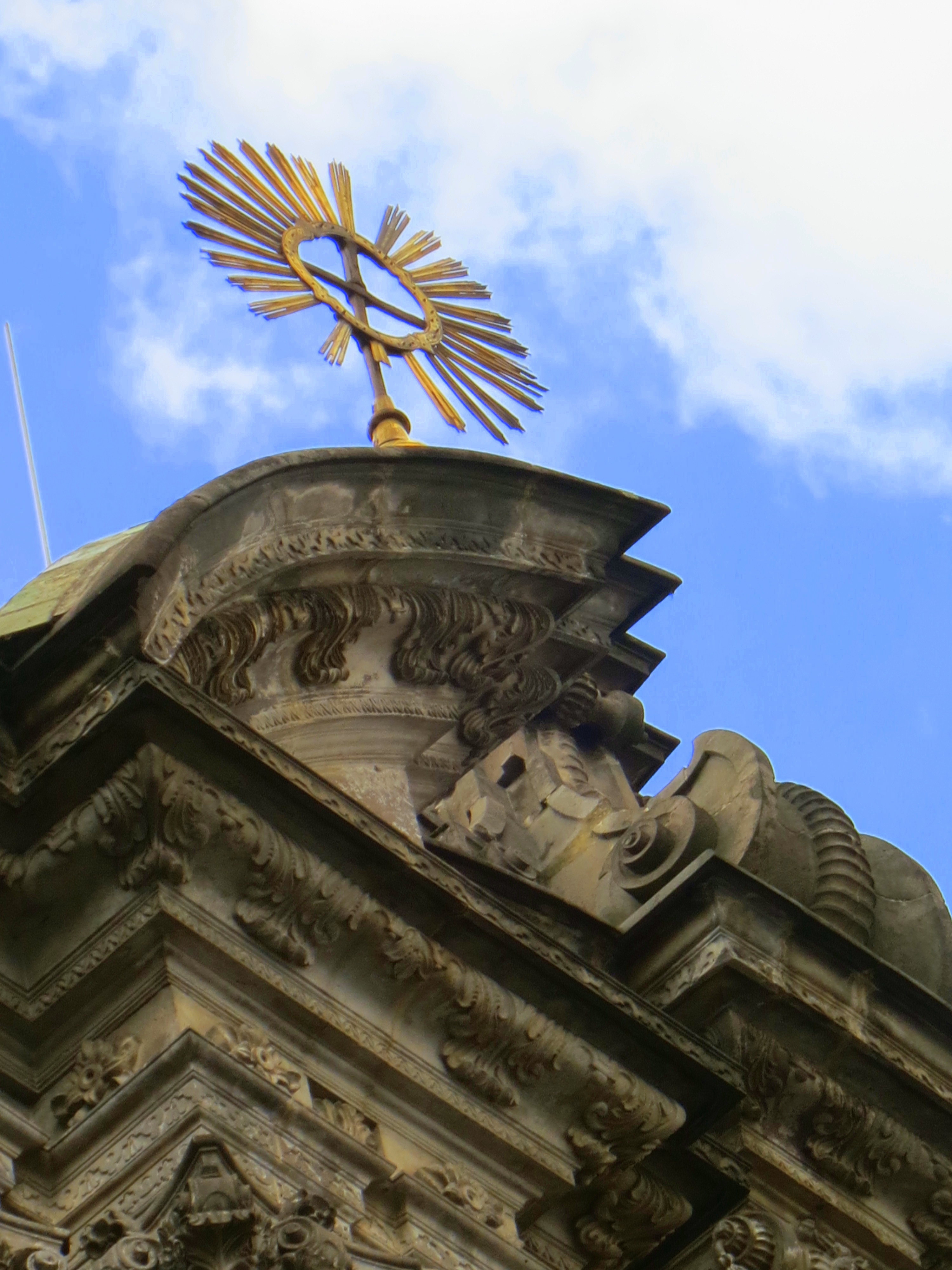
Iglesia de Campana, Quito, Ecuador; February 15, 2014
All right, all right. I know what you want, dearest fellow travelers. Forget anything I might write, you want to see the food! And so, I give you foods of Ecuador, part 1:
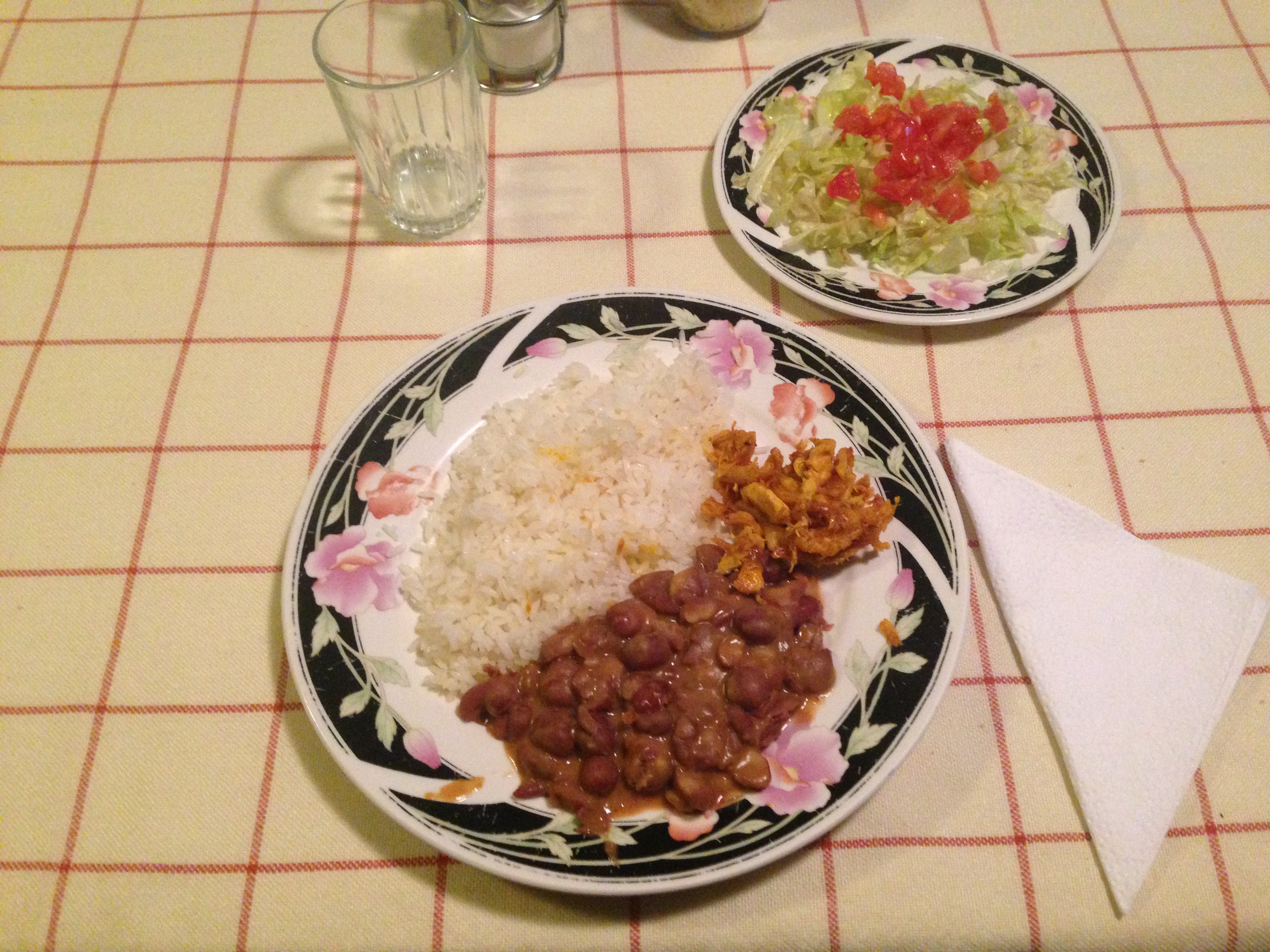
Frijoles con arroz y pollo y ensalata

Bolon de verde con salami y vegetales

Breakfast is the same every day–tea, fresh fruit, toast, and usually fresh fruit juice
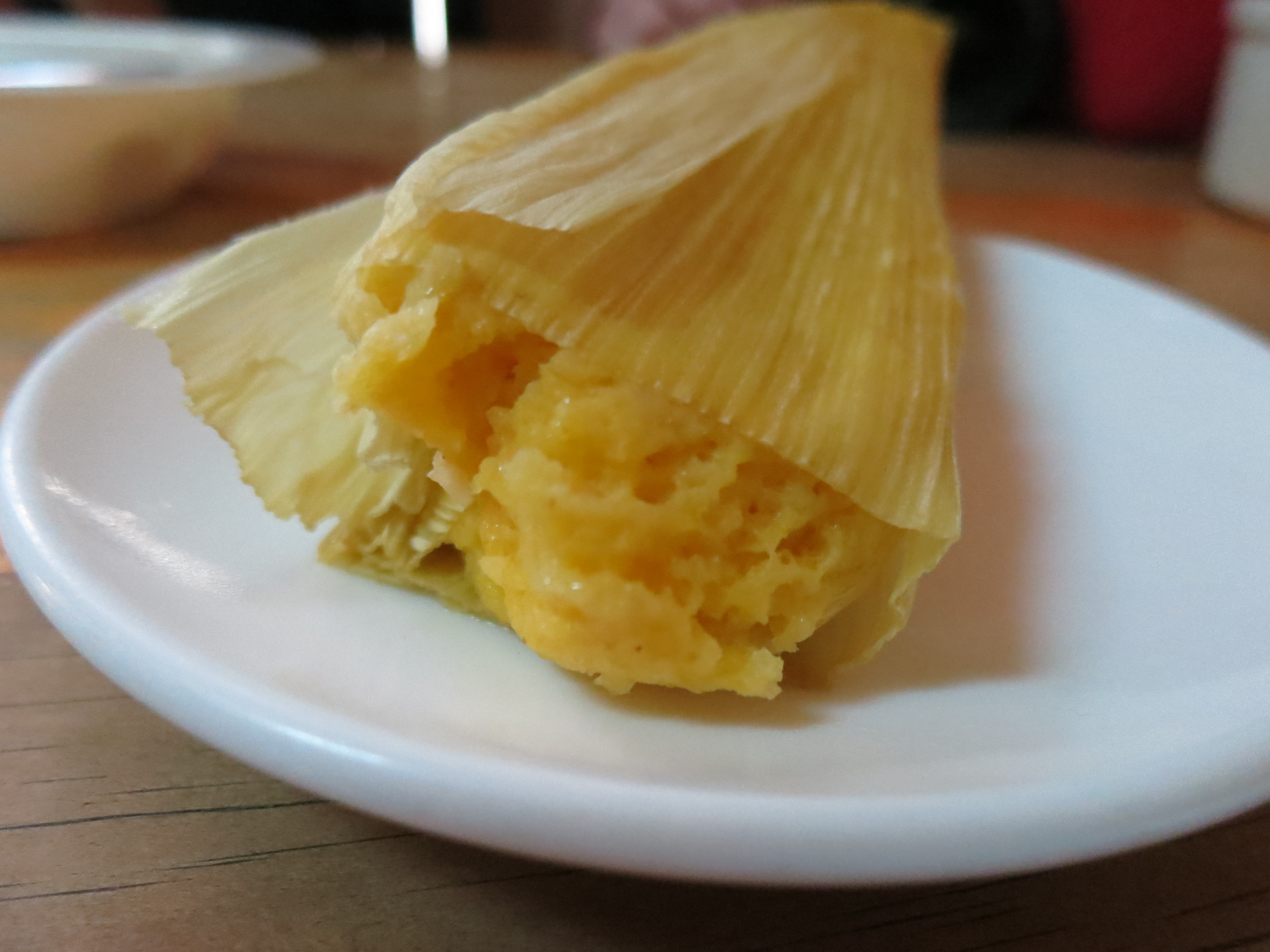
Humita
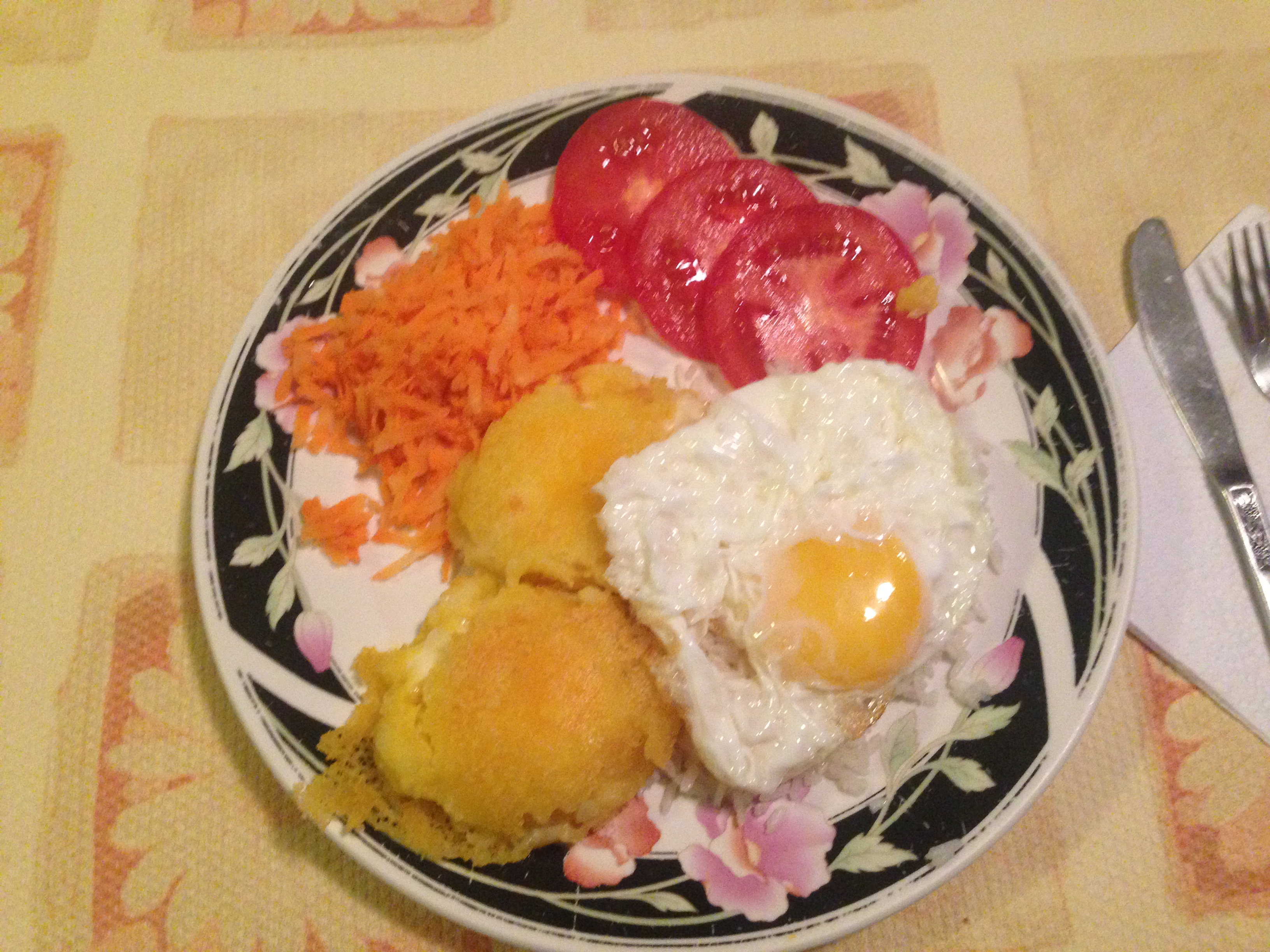
Llapingachos, arroz, huevo frita

Locro de papas
I could eat the mashed-potato-with-cheese-then-fried llapingachos every day, and the creamy corn mixture of humitas is delicious (I also had one of the sweet types of humitas, but forgot to photograph it). Everything in this post is highly recommended!
Credit to my tour group leader for never letting on; the surprise was part of the fun. The school I’m attending for the next two weeks had orientation on Monday, and one of the day’s activities was a short tour of some sights in the colonial center of the city. Six of us new students crammed onto the bus with our genial guide, and tumbled out twenty minutes later for a short walk to the Plaza Grande, the most important plaza in Quito. When we arrived, we were surprised to encounter a partially roped-off square, a booming sound system announcing something, and a crowd of enthusiastic Ecuadorians and tourists. What’s going on? Oh, just an elaborate changing of the guard presided over by the president himself, that’s all.

The crowd assembled for the changing of the guard

President Correa (my zoom doing what it can next to a streetlight)
Had I consulted my guidebook more closely I might have known that this is a regular event. Every Monday that President Rafael Correa is in the city, he oversees a changing of the guard at 11am. It’s a lot of pomp for a weekly event, but I love it; the locals in the crowd enthusiastically sing the national anthem as the flag is raised over the presidential palace, everyone starts their week off with a little ceremony and national pride, and it’s not bad for tourism either.

March of the guard, dressed in uniforms like those who fought for independence in the early 19th century

A large crowd turned out
A band stood at the center of the square, by the fountain, and guards marched on foot and trotted on horseback to surround the band while they played the national anthem. The president and his family stood at the balcony, along with others who I assume are officials and friends. An army man in full fatigues and machine gun stood discreetly to the side, a reminder that only a few years ago, Correa had to be rescued from a life-threatening near-coup.

At least three different types of policing presence
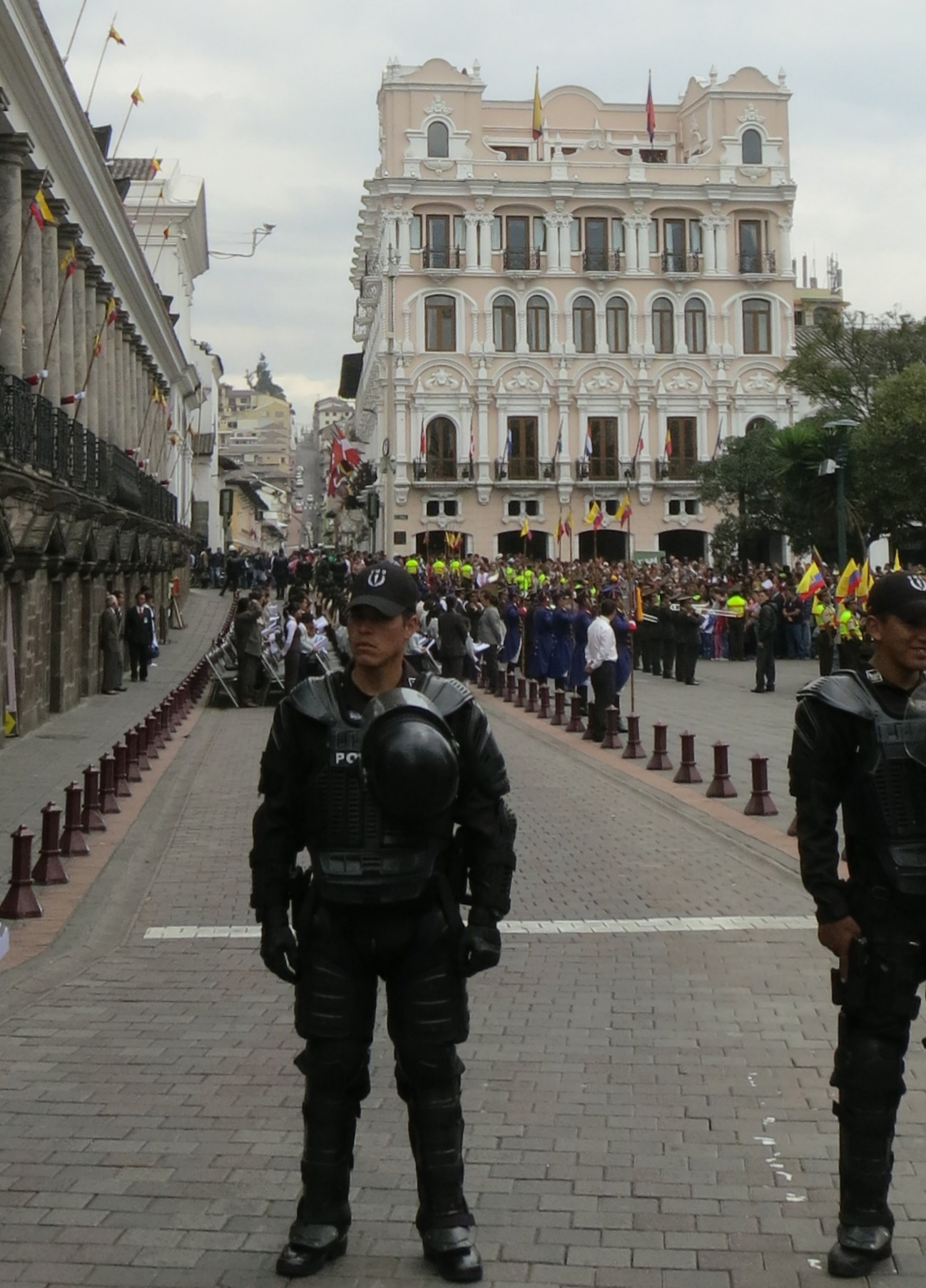
The blocked-off street in front of the palace
The plaza was crowded when we arrived a little after 11am, so we didn’t get a good position for viewing (or photos, for that matter). But I could glimpse the blue, red, and gold uniforms of the guard, and the smiling face of the president; and I could hear the robust singing of the crowd, and the adorably thin voice of one little kid in particular, her fist waving in the air as the flag of Ecuador waved in the wind behind her.
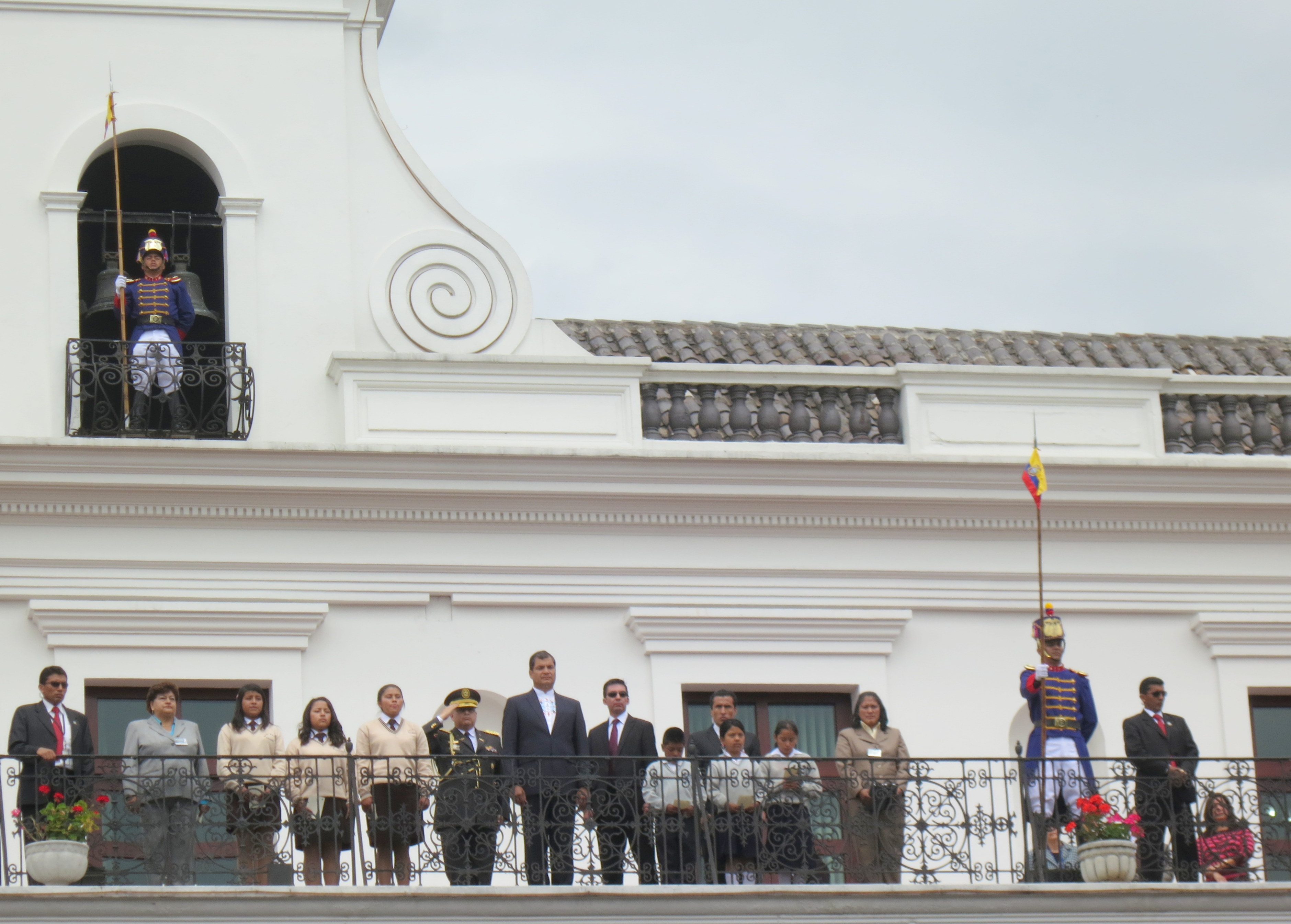
The assembled family and dignitaries

In the Plaza Grande
I made it! After a full 18 hours of travel, I arrived at my hostel in Quito late Friday night. Today I settle in with my host family and start two weeks of Spanish classes. The last time I was in a classroom setting was 2005, so it could be a shock to my system. Also, I really want to learn Spanish but I have to get over my conviction that I’m terrible at languages. Wish me luck!
Quito is high up in the Andes Mountains, 9,350 feet above sea level. I was just in Michigan, which is 800 feet above sea level. That’s a huge change, and I was worried about how altitude sickness would affect me, but luckily it’s just been headaches, which I get a lot of anyway. I took it easy on Saturday–well, I walked 3 miles to see the city, but then I drank a lot of water and napped. That seems to have helped a lot.
I wanted to give y’all a heads-up that an interview I did for a British podcast called Getting Better Acquainted will air on Wednesday. I talk about the first part of my trip, the ups and downs, and being a conscientious traveler. More details when I have ’em!
Finally, I left this:
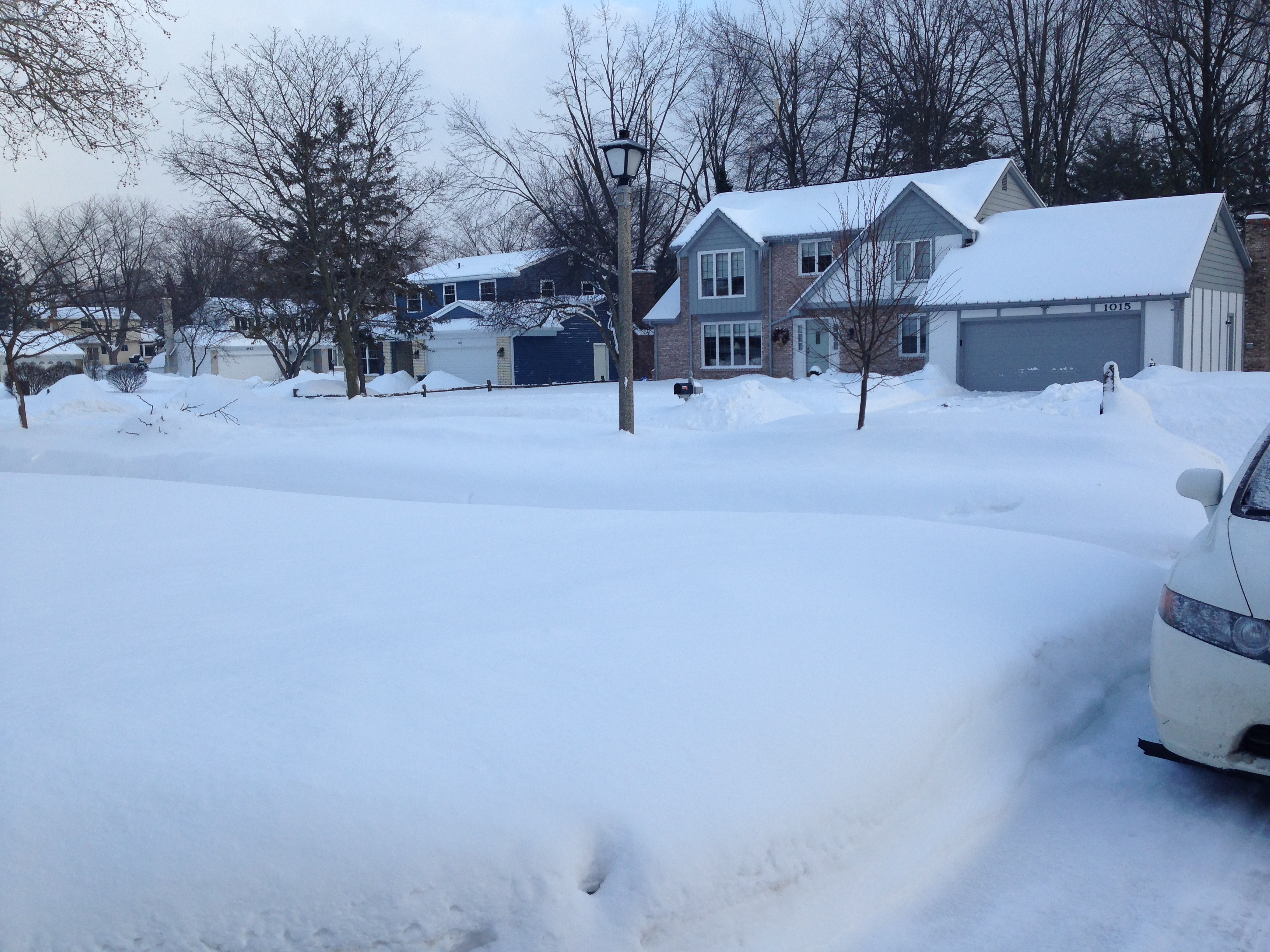
We’ve had at least a foot of snow on the ground for over a month, and days so cold the schools close because kids waiting for their bus might get frostbite
for this:
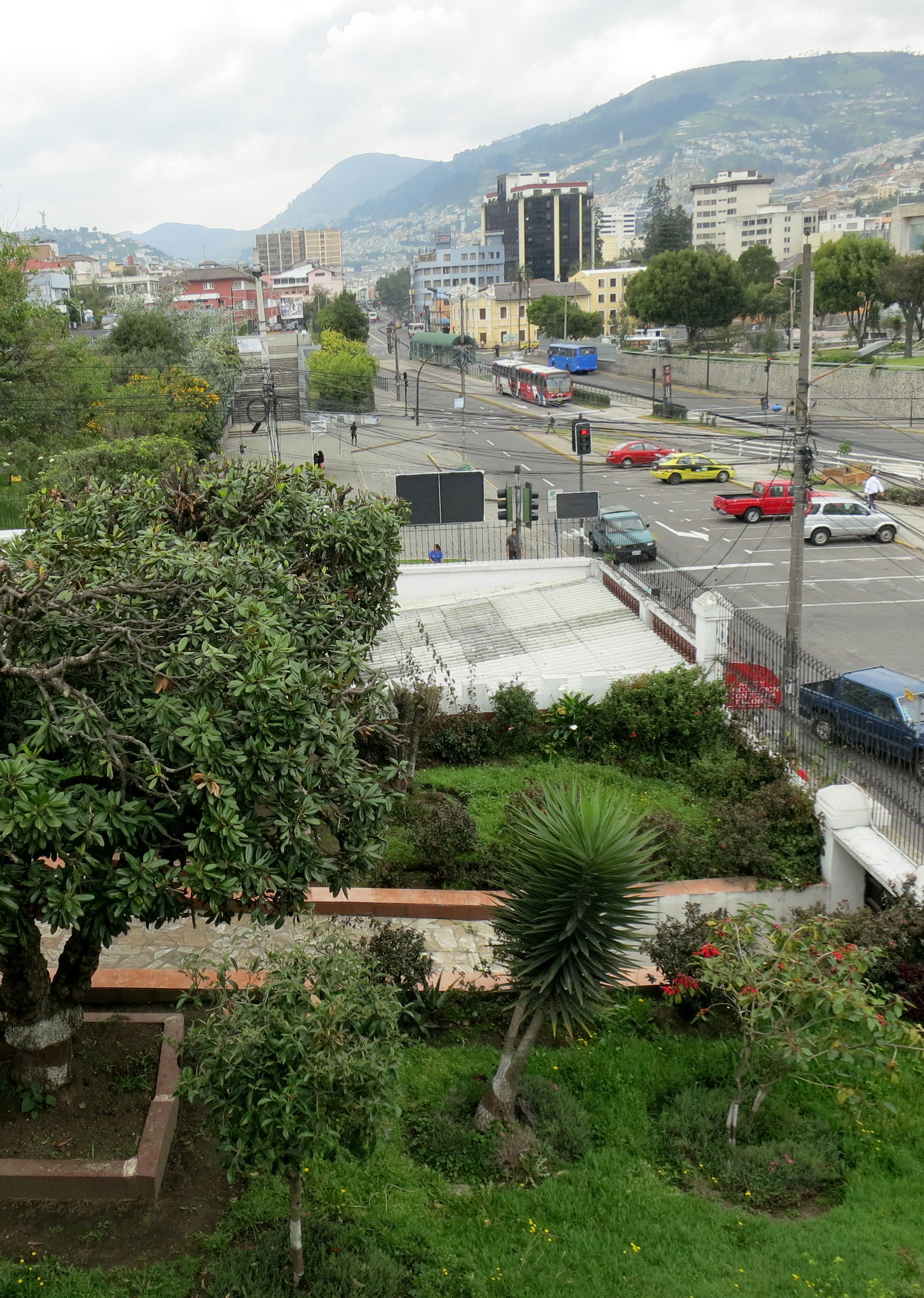
The view from my window in the hostel in Quito.
Sorry not sorry, as the kids say.
Dearest fellow travelers, I have a departure date! Friday, February 7, I will fly Detroit-Houston-Quito. The next Monday I’ll start a two-week intensive Spanish course, to shore up my nonexistent Spanish skills, and from there, who knows? I hope to be on the road for about six months, but we’ll see how it goes. Many thanks to those who have put me in touch with friends who live in or are familiar with South America; I’m grateful for that personal connection. As ever, feel free to email me at lisa dot findley at gmail dot com if you have tips or contacts to share.
I’ve also updated the Fund This Stowaway page. The two major expenses I expect to encounter on this trip are boating in the Galapagos Islands and hiking around Machu Picchu, and I’ve made them the goals you can contribute to if you so choose. (Said with no pressure. Seriously.)
Finally, I’ve updated the About page, so if you send friends over to check out Stowaway (and please do!), they can get a more accurate picture of what I’m up to.
I do plan to continue writing about my travels this past summer, and I’ll also write about the new adventures I’m having, so keep me in your bookmarks or RSS feed or whatever latest technology keeps Stowaway near and dear to you.
Show me the way to the warmer climes
All right, dearest fellow travelers, are you ready to tell me what to do? It’s time for me to be moving on again, and I’m planning to make South America my next destination. If you’ve been, or you know someone who’s been, or you’ve planned your own trip, or you read a cool article once–I want to hear from you.

Sala de Uyuni (salt flats in Bolivia)
Here are a few places I definitely want to go:
1) Machu Picchu (Peru)
2) Iguazu Falls (Brazil, Argentina)
3) Salar de Uyuni (Bolivia)
4) Buenos Aires (Argentina)
5) Amazon jungle (Brazil, Peru, Colombia, Ecuador)
6) Galapagos Islands (Ecuador)
7) Patagonia (Argentina, Chile)
8) Rio de Janeiro (Brazil)
9) Beaches (oh, any country)
10) Angel Falls (Venezuela–I know, the political situation, but it’s still a sight I want to see)

Carnival
Here are a few things I definitely want to do:
1) Spend a month in one town, learning Spanish at a language school
2) Volunteer for at least a couple weeks somewhere
3) Party at Carnival (not necessarily in Rio)
4) Attempt to tango in Argentina
5) See wildlife I’ve never seen
6) Hike at least part of the Inca Trail to Macchu Picchu
7) Find a quiet place to write for awhile
8) Learn to distinguish among the various cuisines
9) Go to a futbol game
10) Dance all night to a local band

Sometimes called The Death Road, sometimes called The Most Dangerous Road in the World–either way, I’m not cycling down it
Here is a thing people do that I do not want to do at all:
Ride a bike down The Most Dangerous Road in the World
**********
So! Whaddya think? Know anyone who lives down there, or have a favorite hostel I should check out? What’s your favorite village I won’t find in the guidebooks but should totally check out? Got any online resources you found useful? Are there places you’d recommend I skip?
I will leave sometime in January, and I hope to stretch the money out for six months of travel. I’ll keep blogging here at Stowaway, and I’ll be working to get published elsewhere too. I’m getting excited for Phase 2 of my trip around the world! Join me.
Dearest fellow travelers, it gives me great pleasure to introduce a guest post from Sessily Watt, a good friend and fellow K alum. A few weeks ago, she and I were discussing the comments on the Great Expectations post, and about what it means to live in a different country rather than simply visit it for a short time. Sessily is a writer living in Chicago, and her post reflects on her time spent living in Ecuador in 2005. Enjoy!
*********************************************************************************************
We were standing on a sidewalk between several medical buildings, in the middle of a tour of a small hospital in Ecuador, when the woman approached us. (Or maybe she was our guide through the buildings, and it was at this point that she asked us about who we were. Time has passed. The memories have shifted.) After a flurry of conversation she was under the impression that some or all of us were medical students, and offered for us to come and observe a birth that was happening at that very moment. She led us back through the buildings to the doorway to the delivery room, where it became clear that observing a birth meant all ten of us (nine students and one of our program directors) crowding into the delivery room and its doorway. Four of us had already felt uncomfortable as we approached the room, and our discomfort increased. We waited a moment, but it was soon clear the rest were planning to stay and watch, so we left them there, walked out of the building, through the waiting area where the pregnant woman’s family was waiting, out the front door to a set of benches in front of the building. We sat down.
Out on the benches, we were split again by the cause of our discomfort. Two, male, were personally uncomfortable with watching a woman give birth. Two, female, were uncomfortable that we had been welcomed into that room without permission being asked or granted from the woman who was lying on that table with her legs spread. Our fellow students were back in that room, with their cameras out. We waited.
The nine of us had been together in Ecuador for five months at this point. One of our program directors, who was with us that day, had led us on three previous trips as a group. We had already passed through that stretch of time where we got on each other’s nerves, and now we were a more or less cohesive group. The people who chose to stay in that delivery room and watch the birth were (and are) perfectly nice, lovely people. I enjoyed traveling with them. But I judged them for staying in that room.
Traveling, especially as a tourist to another country, can lead to a sense of entitlement to see anything and everything. In my opinion, the people who stayed in that room were acting out that entitlement. They weren’t medical students. Their presence served no purpose for the woman lying on the table. They were simply there to see what it was like. (In the case of at least two people, who have since gone on to medical school, I can see how this experience was edifying. And, who knows, maybe in some way it will prompt them into actions that improve the delivery of medicine, etc etc, but those benefits move us further and further away from that woman on the table who was not helped by them and who did not give her consent for them to be there.)
A study abroad program like the one in Ecuador is designed to encourage students to take part in society as if they aren’t tourists: we lived with host families, attended an Ecuadorian university, and ended the program with an internship/volunteer position in an Ecuadorian organization. One would hope these experiences would lessen that feeling of entitlement to see everything. To a certain extent, we lived in Ecuador for six and a half months, rather than traveling there. Especially during my last month in the country, volunteering at an organization where I worked with Ecuadorians, Germans, and French, I felt like I had found a niche for myself. I woke up in the morning, rode the bus for eight stops, picked up a copy of El Comercio from the newsstand, and walked three blocks to the corner building where the organization had a series of rooms on the second floor. Sometimes I went to lunch with my coworkers, sometimes I walked to a sandwich place that was nearby. My coworkers and I tutored kids in the afternoon. Some afternoons I was bored, others I was outraged, or sad, or content. In the evening, I visited with my host family for a little while before I went to bed. Some nights I went out. By living in Ecuador I learned that I enjoy large cities, can’t imagine living without public transportation (though I grew up in a small town without it), and when I’ve moved to a new place I feel anxious about leaving home until I get out and walk around, take a bus or two, and maybe get lost. Without living in Ecuador, I may never have considered moving to Chicago.

La Casa Amigos, where I volunteered during my last month in Ecuador
But no matter how well designed, a study abroad program couldn’t make us Ecuadorian, and the trappings and support of the program at times increased the feeling of being a tourist. When we went on the program-designed trips, we traveled in our own bus, a little bubble of pirated American movies and Seinfeld episodes. There were always nine of us to compare to all of them, emphasizing our differences. Like any other tourist, we were there to see the country, to experience those cultural differences we heard about in our pre-trip lectures. Perhaps even to “broaden our horizons.” Yes, there are real benefits to exposing ourselves to differences–not to mention that it can be a lot of fun–but that focus on cultural differences, in combination with other factors, leads to forgetting that those people aren’t there to open themselves up for us to examine.

the bus we traveled around in for our program trips
Every traveler has a different line they draw in how far they will go to experience it all. The other students in my program didn’t feel uncomfortable with their experience in the delivery room. The doctors were fine with their presence. The woman supposedly thanked them after it was all done (cynically, I ask, “Did she even know why they were there?”). As a very private person, I imagine that my line comes much earlier than others. By not staying in that room, I may have missed out on an amazing experience. I’m willing to imagine there are other instances where, if I had been willing to press a little harder, to dig in a little more, I might have had other theoretically amazing experiences. But.
I traveled by myself once while I was in Ecuador, right at the end of my time there. Throughout that trip, I often felt different from the people I was with, and like I didn’t belong. But it was during that trip I felt the least like a tourist. I wasn’t there to see the sites. I wasn’t there to see what life was like in this coastal city. I was there to visit a specific person, because I thought I would regret it if I didn’t visit her. It was in those moments when I was living my life and just happened to be in a country different from the one I grew up in–traveling by myself, volunteering–that I felt like I had the clearest glimpses of Ecuador.
 Stowaway Travel Writing & Editorial Services