Where in the World Wednesday

Image

Adams and Clark, Chicago, IL

Adams and Clark, Chicago, IL, June 29, 2008

Here’s a new feature: Where in the World Wednesday. I figured, I talk about places I’ve been enough, but maybe there aren’t enough photos. Everyone loves a picture. So every Wednesday, I’ll post a photo from someplace I’ve traveled for your viewing pleasure. Enjoy!

Aesthetically Speaking: Kelsay Myers

Hello, dearest fellow travelers! I’m very excited to introduce a new recurring feature here on Stowaway: The Aesthetically Speaking series of artist interviews. I know so many people who make art, whether as a main occupation or something they pursue whenever they can, and I wanted to hear more about their processes and philosophies. So I wrote up a list of questions and sent them out to friends far and wide, and each week I’ll post their answers here. I strongly encourage you to ask questions in the comments and check out their websites, shows, etc. Many thanks to all the artists who sent me such thoughtful responses. I appreciate your taking the time and sharing insight into what art means to you.

The inaugural interview is with Kelsay Myers, a friend of mine from Kalamazoo College. I remember Kelsay as an energetic force in our campus’s feminist organization, and when we did the feminist fashion show her keen artist’s eye was invaluable. Kelsay lives in San Francisco and, as you’ll see from her interview, is totally immersed in the arts scene there. Thanks for sharing, Kelsay!

What is your name and city of residence?
Kelsay Elizabeth Myers, San Francisco Bay Area

What medium do you work in?
Creative writing and found art installation

How often do you work on your art–is it a full-time endeavor or something you work on in your spare time?
Currently, I spend most of my time working on writing, art or arts-related projects. I am trying to live the artist’s, or writer’s life and go wherever the work takes me.
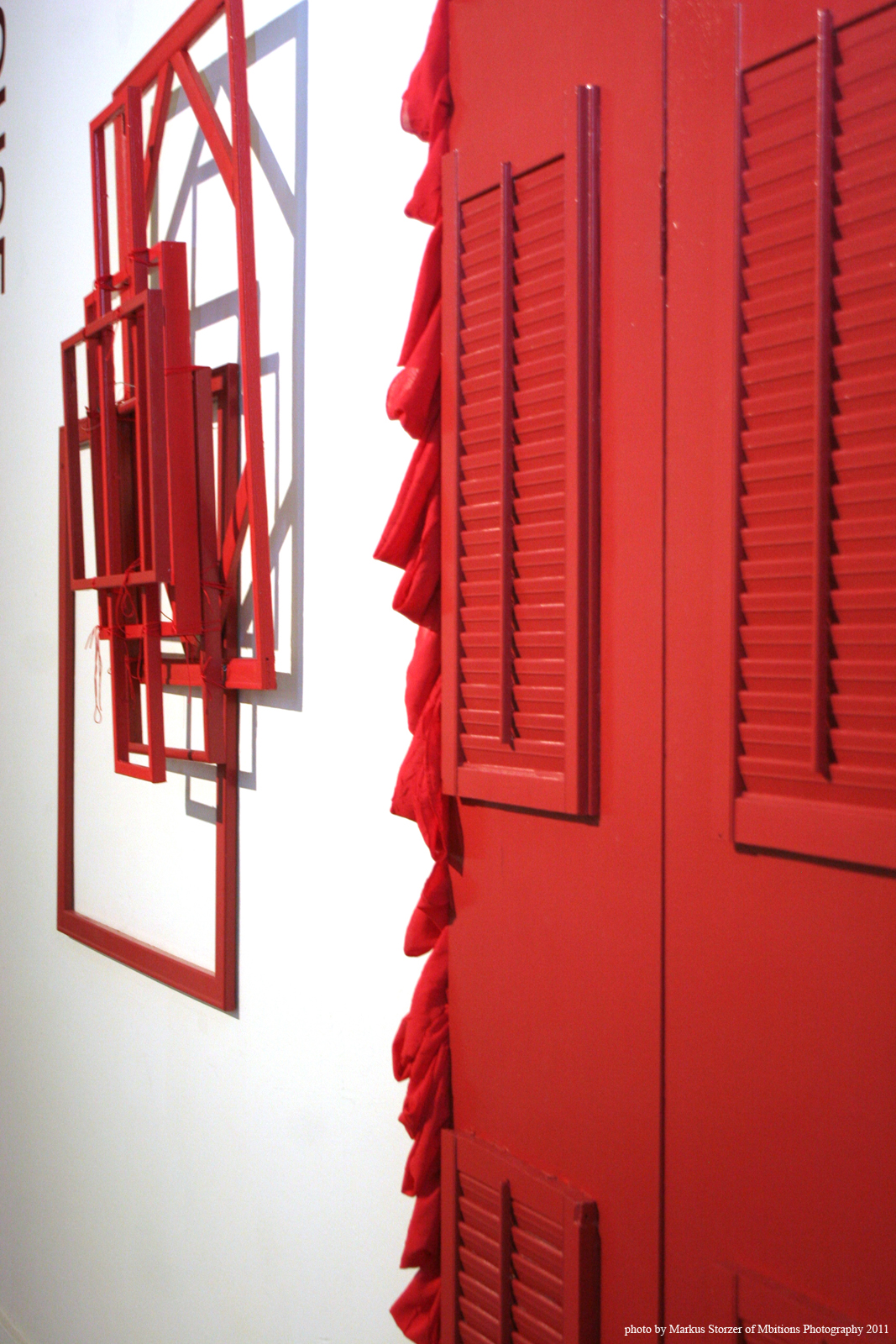
The Red Frame by Kelsay Myers

The Red Frame by Kelsay Myers


How does art fit into your life, in general? Is it something you think about and talk about every day, or every week, or only in certain situations, etc.?

I admit that I might be a bit of an art-a-holic. I am thinking about my writing, or future writing projects, or future art projects, or ideas for art projects, or what I should or could be doing with my writing constantly. I talk about it with my friends, colleagues and family. I tweet about it with some consistency. I do it with somewhat greater consistency than tweeting about it.

This might be a by-product of moving to California and falling into both a writers’ community (the MFA Writing community at Saint Mary’s College of California) and an artists’ community (Asian American Women Artists Association). Or, it could be because when I moved to the East Bay, I was ready to devote myself to my writing, and I tend to go full-throttle when I decide to do something.


When you start on a piece, what kind of end result do you have in mind? Does it get performed or published, put in a permanent form or is it more temporary?
It’s different each time. Each piece has a life of its own, but some things are the same. I always create for myself, but I also always want to share my work whether it’s through publication, a literary reading or a performance. It’s part of the Di Seuss model of creating—write because you have to, because you have no other choice and then send it out into the world to hopefully connect with others. Then move on.


What goals do you set in relation to your art, both short- and long-term? Is it something you hope to make money doing, or is it something you want to keep uncommercialized? Does the term “sell-out” hold meaning for you or do you see the art/commerce relationship as a necessary one?

“Sell-out” is something I’m concerned about. Not from the art/commerce side of things since the ability to make money doing art or writing is the ideal for me. I worry about becoming complacent, not challenging myself to move into new artistic territory, repeating myself or being convinced to make choices that I know would be a disservice to the integrity of the work. But I’d like to think that I would never allow that to happen. I guess time will tell.


What role does collaboration with others play in your art, if any?

Collaboration hasn’t come up for me very often, but I would love to collaborate. I think a piece can benefit from having more than one voice and more than one person’s mission influencing it. 


How conscious are you of your artistic influences? Who are your artistic influences?
Risa Nye said it best when she told me that my writing is very inspired and inspiring. While I cannot really speak to that last part, I do think my writing is very inspired and purposefully so. My goal is for someone else to find my writing half as inspiring as I find other writers’ to be. I haven’t written anything without directly quoting at least one of my artistic influences because I don’t see my work as being created in a vacuum, either in content or in structure. I want to honor the voices of the people who influence my work within my work, and this is something I will not compromise on.

I don’t think it’s merely the academic in me wanting to re-enforce my argument with the evidence of others either. Actress Fanny Ardant captured the idea brilliantly when she said: “As a girl, whenever I read a beautiful passage in a book I would run to my sister and read it to her. It is the feeling that you have to share the beautiful with someone else.” I find beauty everywhere: in a painting, in a book, on the silver screen, in my friends and colleagues, and I want to share that beauty with the whole world.

Aside from the women I have already mentioned in this interview (Di, Risa and Fanny), specific artistic influences are Carole Maso, Friedrich Nietzsche, Kimiko Hahn, Yoko Ono, John Irving, Walt Whitman, SØren Kierkegaard and Marilyn Abildskov.
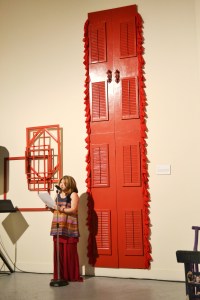
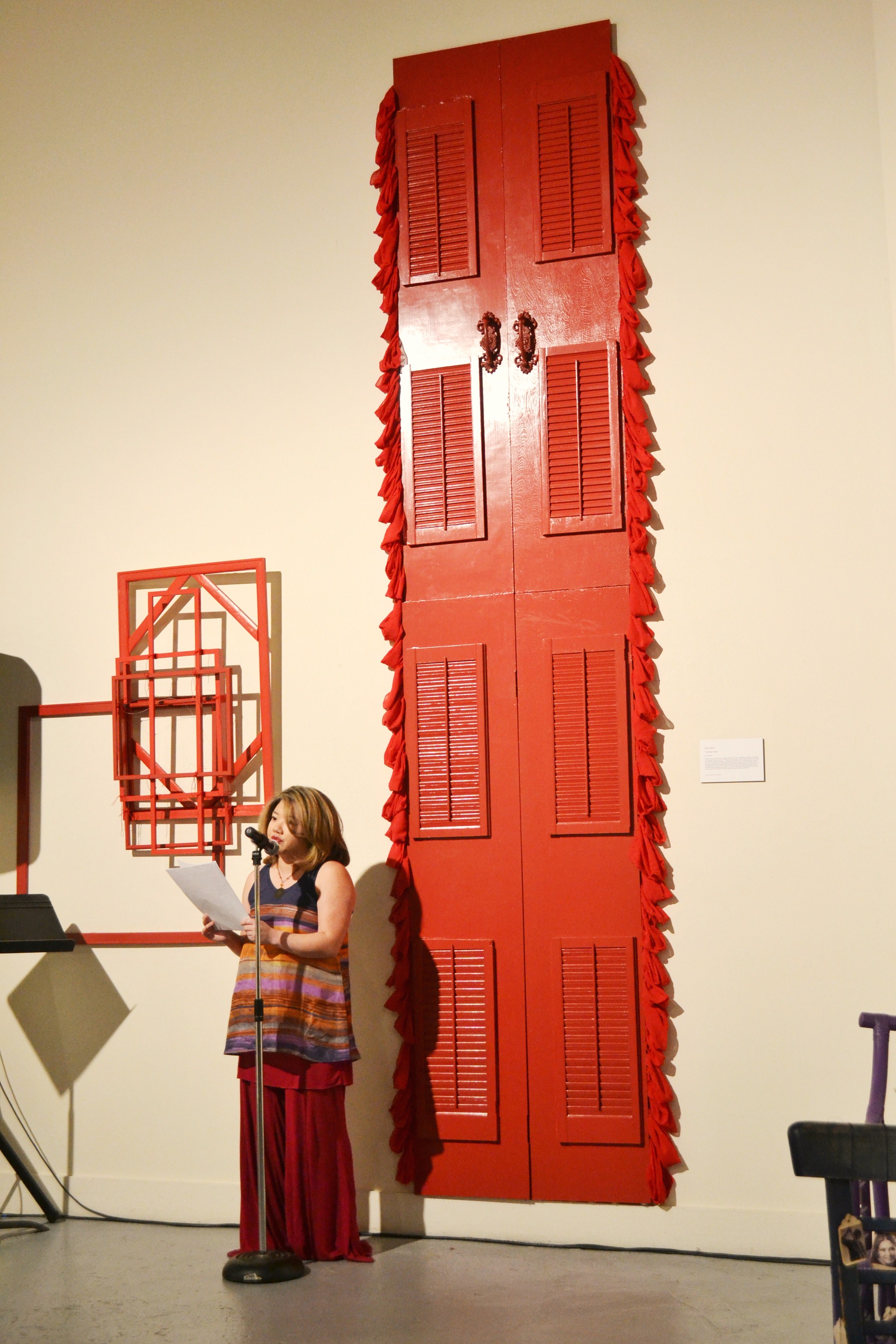
Kelsay at the "A Place of Her Own" exhibition at SOMArts Cultural Center

Kelsay at the "A Place of Her Own" exhibition at SOMArts Cultural Center

Since this is a travel blog, how does travel relate to or affect your art? (Themes in what you produce, road trips to perform your music, thoughts on what happens to your painting when you ship it across the country to a customer, etc.)
Travel comes across in a lot of my work in some way or another. As a transracial and transnational adoptee, a certain amount of displacement exists in everything that I write. For example, the large red doors I constructed from found objects in my first art installation at SOMArts Cultural Center in San Francisco this past May were dubbed “very Asian” by some other artists in the show, which I found interesting since the lyrical essay that inspired my installation included a lot of imaginary scenes that take place in Busan, South Korea. It’s an essay where I imagine my birth parents and birth story in different ways, and I suppose the Asian side of me came out, too, in ways that it hasn’t been able to before.

Even if travel itself isn’t mentioned, place is important in all of my writing. I have lived in quite a few cities, and all of them have impacted me, which tends to come out in the writing, depending on which city I was living in during the time of the piece. Budapest, Hungary, where I lived for five months during my Study Abroad in college, is a place I associate with themes of freedom and escape. California and Korea are both places that have lived in my imagination for years as ideals and foils to my hometown of Lowell, Michigan. All of these are issues I write about or work out in my art.


And finally, a right-brain question: If your art was a map, what would it be a map of?

The United States of Asian America, as lived by one Korean American adoptee.


If you’d like, share your website/Facebook page and any upcoming gigs/plans you’d like readers to know about.

Photo 1 credit Markus Storzer. Photo 2 credit Nicole C. Roldan.
ACAM: The Time Warp Effect of Travelogues

I’ve just finished Hard Travel to Sacred Places by Rudolph Wurlitzer, and I was struck by how of its time it is. Published in 1994 (written in ’93), it’s about Wurlitzer and his wife traveling to sacred sites in Thailand, Burma, and Cambodia as they grieve the sudden death of their son. They’re American Buddhists looking for some measure of peace at various temples and shrines, and the book is full of quotes from various Buddhist texts and religious thinkers.

book cover of Hard Travel to Sacred Places by Rudy Wurlitzer

travelogue/time machine

The jacket copy on the book mentions the word “classic” more than once, and certainly Wurlitzer’s meditations on grief and loss are moving and timeless. How do we cope with the death of a child? How do we hold that unspeakably personal sadness and also hold the tragedies of deaths on a massive scale in various parts of the world? How does the death of a loved one force us to face our own mortality? Wurlitzer’s prose is simple and swift as he grapples with these questions, and I appreciated his insight even while I, as someone who doesn’t practice a religion, couldn’t quite grasp the religious framework he’s working with.

So that part was, despite the personal nature of his grief, universal and timeless. But the rest of it was so specific to 1993! He’s horrified by the commercialization of Thailand, specifically the Coke-drinking, sex trade-working, neon-lit city of Bangkok. Now, of course, the seediness and Westernization of Bangkok is well-known and few travelers are surprised by it when they visit.

In Burma–wait, he visits Burma (Myanmar). That, right there, is different from now. According to Wikipedia, about 800,000 people visited the country in 2010, compared to 1.13 million overseas tourists visiting Chicago alone in 2009. When Wurlitzer visited, Aung San Suu Kyi had only been under house arrest for a few years, after the 1990 elections that saw her party overwhelmingly elected were disregarded and the military junta decided to stop having them for awhile. Wurlitzer talks about an antiquated country, one with very little new industry or commerce since the outside world isn’t dealing with the junta (his descriptions sound like descriptions I’ve read of Cuba), and while he wonders at the brutality of the junta, he sounds relieved to be in a calm, quiet country after the electric buzz of Thailand. Nowadays, some groups advocate tourism to Burma to bring money to the local people and help them keep in contact with the outside world, but most activist groups discourage it, since the junta has forced labor in tourist destinations and the industry mostly supports the junta and not the people. A far cry from the sleepy country Wurlitzer visited almost 20 years ago.

In Cambodia in 1993, the Khmer Rouge were still a major threat; Wurlitzer heard gunfire and saw holy sculptures vandalized by people taking parts of them over the border into Thailand to sell on the black market. He describes a country in chaos, with elections right around the corner, but no one sure of who will win or who ought to win. Today, Cambodia has finally prosecuted some Khmer Rouge as war criminals, and humanitarian groups have sprung up all over the place, but its prime minister, Hun Sen, has kept in power through some very shady means, and the country is still one of the poorest in the world. The biggest change on the ground is the lack of Khmer Rouge with guns around every corner, although the mines from the civil war that could blow up at any time in 1993 can still blow up on any unlucky pedestrian today.

I enjoyed reading Hard Travel to Sacred Places both for Wurlitzer’s thoughts on death and grieving, and also for the time warp experience. It’s fascinating to read a contemporary travelogue alongside a history textbook and see how personal experience intersects with facts.

Image from here.

Three Steps to Keeping Your Belongings Safe on the Road

Or: I Did NOT Leave My Wallet in El Segundo

I’m paranoid about losing my keys or having my wallet stolen, especially since I’ve lived on my own and faced the prospect of being unable to get into my apartment if my keys go missing. So I’ve developed some overly paranoid steps to minimize the risk of these things happening. Most travel guides and websites will give you tips on how to keep your things secure when you’re in a foreign place (get a bag that zips, carry it across your chest instead of at your side, etc.), but the truth is that the same strategies work anywhere, whether at home or abroad.

Step One: Run “Ready, Set, Go”

Every single time I leave my house, I run a “ready, set, go” check. Look in my purse for keys, wallet, phone. With those three things, I’m good anywhere I end up. The one time I didn’t check, of course, my keys were still in my bedroom, and that was when I lived in a place with automatically locking doors. Not a pleasant realization, when I ran the ready, set, go after I’d already let the door close behind me with a sharp click.

Step Two: Develop a New Plane of Awareness

The CTA posts ads with tips on deterring pickpockets, including a recommendation that you not check for your wallet in your back pocket, or run a finger along your phone’s outline in your purse, or in some other way indicate to a thief the exact location of your valuables. But I don’t feel comfortable not being able to check up on things, so I’ve developed a a system of constant movement that allows me to check on things without being too obvious about it; I shift my purse from one arm to the other, and do a quick tactile check on its contents, or open it up to take out my chapstick or iPod, and do a quick visual check that way.

Step Three: Be Lucky

Okay, this is a bit of a cheat, since the very definition of luck includes being unable to control it, but I think it’s important to recognize the crucial role luck plays in keeping our belongings secure and our persons safe. There are a lot of steps we can take to protect ourselves, but sometimes thieves succeed or accidents happen, and all the precautions in the world can’t help in those instances. I mention this because I think it’s easy to blame people for not being careful enough with their things, and that’s not helpful. Especially when you’re traveling someplace new, it’s easy to get disoriented and lose track of your usual habits that keep your things with you, and if you get separated from those things, you won’t want it to ruin your trip. Do what you can to keep your belongings secure, but if misfortune strikes, remember that they are all replaceable, unlike the more pleasant memories you’re forming while traveling, so do your best to focus on those instead.

Any other suggestions?

It’s A Small, Horrifying World

I’m 2/3 of the way through John Tully’s A Short History of Cambodia, and page 104 made me put down the book and say out loud, “holy shit!” When World War II started, Cambodia was still a French protectorate. In 1940, the French government capitulated to Nazi Germany and the Vichy government took over, and the governor of French Indochina, Jean Decoux, went all-out in his support of the new regime. Partly this was because Japan (a German ally, as we all recall) was quickly moving south, and there weren’t enough French/Cambodian troops to resist if they tried, so he wanted to put on a good show of support. But hoo boy did Decoux go all in. The press switched immediately from siding with the Allies to spewing hatred against Jews and cheering Allied losses. He had members of youth organizations goose-stepping in parades and doing the Nazi salute. (Tully even says that he set up concentration camps, although he doesn’t say where or who was imprisoned, and I can’t find independent verification of this.)

There’s a picture in the book (can’t find one online) that shows Cambodian youth goose-stepping. They’re all doing the Nazi salute in front of a parade dais. I just found it utterly bizarre to see Khmers doing an Aryan salute, to see that specific gesture of European terrorism imitated in Southeast Asia. The politics of why Decoux adopted these symbols and gestures for his protectorate are clear, and the Cambodians were in little position to resist his orders, but it’s still sickening and dizzying. That it reached to the other side of the globe — it really was a world war.

Travel as Exploitation, or Whatever

Oh the hilarity! I mean, also sad, because I have definitely met far too many travelers whose inner monologue is probably shockingly close to this little satirical piece (without that hard-hitting bit at the end). And I have to watch myself closely to not go too far into this territory, too. But mostly it’s hilarious. Check it out:

“When I reached the end of the alley I saw this really elderly and impoverished Guatemalan woman, with like, missing teeth weaving brightly colored cloths on this big weaving apparatus. And I stopped, for like a whole three minutes and we exchanged a really long glance. I felt like I could see into her soul. I took some photos of her, like, without asking. I remember how pleased I felt, that I actually found something in that alley entirely mine. Like, I owned it or something.”

When we travel, what are we learning, what are we taking, and what right have we to do any of it? Those are the questions I hope we’re grappling with in this here blog.

Note: No need to be familiar with My So-Called Life for this to be entertaining. The author’s writing in the style of a 16-year-old TV character from the early ’90s, but that’s just icing if you know the show. (Which honestly, I don’t; I think I’ve seen one and a half episodes, and it was in this past year, so I missed out on the part where I strongly identify with Angela and draw parallels between her life and mine.)

I’m Covered in Bees!

Hello, dearest fellow travelers! Did you miss me? I did you.

I shall now summarize for you my vacation last week: More, please.

As I’m sure you all know, coming back from vacation should be done as gently as possible. No matter how relaxing the vacation (and a week on a beach with old friends was quite relaxing), coming back is a shock to the system. I cleverly dealt with the problem this time by having a whole weekend to myself before heading back into the workforce. Saturday was movies, Sunday was laundry and a new book, and by Monday morning I was almost able to bear the thought of sitting in a cubicle instead of swimming in a lake. Self-brainwashing, sure, but necessary in order to earn more money to take more vacations.

And of course, last night I supplemented unpacking and books with a healthy dose of Eddie Izzard. Nothing says “you can handle the office” like giraffe impressions and “I’m covered in beeeees!”

New Centerstage Review Up and Vacation Announcement

I recommend you see “We Live Here” at Greenhouse Theater Center in Lincoln Park. It’s an original work, with eight authors contributing individual stories of their quintessential Chicago moments. It’s a snapshot of Chicagoans approaching 30, and as such the stories skew young. A couple stories hint at more experienced writers (a woman who miscarries several times, a man who lived in the Tree Studios when they were still artists’ living spaces and not chi-chi shops), but mostly the stories are about bike messengers, recent college grads, people making their first big move or recovering from their first big heartbreak. It’s about people starting out or just starting over, and as such it’s infused with an exciting energy. The cast is marvelous, and the nimble direction kept my eyes riveted to the stage. Here’s an excerpt of the review:

But perhaps the highest praise I can give for this show is that the next day, as I sat in a train car lurching along the el, I looked around the car and wondered what stories my fellow Chicagoans were just waiting to share.

You can read the rest of the review here.

*************************************************************

In other news, it’s vacation time! I’m headed to my last wedding of the summer and a beach house rental starting on Friday, and I can’t wait. I won’t be posting next week, so try not to pine away too much, and I’ll be back on August 23rd. Do come back then! Wouldn’t want to lose any of you lovely readers. Have a great week.

The Music Don’t Lie, Part 3

I have a fraught relationship with music and driving. I mean, of course I love music and I listen to it constantly when I’m in the car (no dry talk radio here). But I seem to have an uncanny knack for finding myself in trouble just as a song’s playing that’d make you go, “and isn’t that ironic, don’tcha think?” (I will pause now for you all to wail along to Alanis’s logic-flawed but bellow-perfect chorus.)

Back? Feel refreshed? Excellent. Onward!

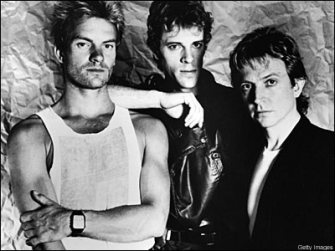
Example 1: I was about 10 years old and my mom was driving the twins and me somewhere on the highway. We’re grooving to “Roxanne” (the meaning of which utterly escaped me for another 4 years or so, I’m happy to say), when suddenly, sirens, lights, and we’re on the side of the road. Mom has a short conversation with the police officer, who probably lectures her on speeding while transporting her “precious cargo” (this phrase has actually been used in reference to child passengers, ew). And then as soon as the police officer turned back to his car I make it SO MUCH BETTER by saying, with utter lack of facetiousness, “Mom! Mom! Isn’t it funny that The Police were on the radio, and the police just came to our car? Mom, isn’t that hilarious?” I do not think she found it hilarious.

The Police

Possibly my mom wouldn't have minded so much if these officers had pulled her over.

Example 2: The universe got me back about 7 years later. I was a few days shy of my 17th birthday, when my driver’s license would go from temporary to permanent. I was driving around my hometown, hand delivering invitations to my 17th birthday party, which was to be in the theme of the original Star Wars. (Raise your hand if you’re surprised that this is the kind of party I would throw.) I slowed down for what seemed a respectable amount of time at a stop sign on a residential street and carried on to a main street, where I was promptly pulled over for not stopping at a stop sign. My first ticket, my first time crying in front of a cop, and what’s on the radio? “Free Bird.” No joke.

Lynyrd Skynyrd

Skynyrd definitely look like they're waiting to be booked at a police station.

Our latest example came last night, an instance of Instant Karma Gone Wrong. It was pouring on my walk home from the train station, and I passed a woman giving terrible directions to a couple of guys with guitars and travel backpacks. I corrected the directions after the woman walked away, but when they said thanks and they’d start walking now, I said, wait, that’s almost 3 miles away, let me give you a ride. So I drove them to their friend’s house and wished them well. On my way back to my house, rain drummed on the roof, the radio played “Classical Gas” (that instrumental that is clearly made for cruising along in a car), and I started to plan dinner in my head. Then I heard a rumble and it wasn’t thunder. My front left tire blew out, and I rolled along as the wheel moved farther and farther off its axle, til I got to a tire place that was actually open. They fixed it quickly and I headed home, $60 poorer and wary of any song even remotely referencing driving, or freedom, or law enforcement.

Next time I hear “Crash and Burn” by the Bangles on my car radio, I’m pulling to the side of the road and just running.

Previous editions of “The Music Don’t Lie” found here and here.

Image 1 from here. Image 2 from here.

Sex on the Road

Nerve.com had a feature up this week asking travelers about their love and sex lives. (This being Nerve, you might not want to click through if your office has filters up, and you might not want to read on if you don’t want to read about my views on sex while traveling.) It’s a quick round-up of questions they asked a few people at a bar in Colombia, but I think it’s a pretty accurate slice of the average backpacking population. (ETA: I realize they’re asked very leading questions in the vein of “make your travel sound as sexy and illicit as possible,” but still, you can choose how to answer those.)

If I knew how to Photoshop, I'd put some suggestive silhouette on here to show you what the Sexy UN looks like.

The main themes seem to be:

1) Travel is better when you’re single because you can get laid more.

2) In fact, even when you’re dating someone while traveling, be quick to emphasize just how complicated and non-serious the situation is lest you feel too tied down.

3) Indulge yourself in broad generalizations about the sexual proclivities and romantic tendencies of different ethnicities.

I can really only sign off on #1, and that only if you’re not traveling with your partner. If you’re traveling with your partner, that’s a whole different kind of fun travel.

#2 just makes it sound like backpacking is the ultimate refuge of commitment-phobes, and #3 is not only inaccurate but gross.

I’ve certainly met plenty such travelers on the road, people who consider themselves ambassadors to the sexual United Nations. They use much the same checklist for their dicks as they do for their backpacks; has it been inside as many countries as possible?

And yeah, I just generalized them to be guys. There are women out there with a similar attitude, but overwhelmingly it’s dudes doing this kind of sexual tourism. Even in that Nerve interview, the woman who says she prefers to be single talks about being happy with oneself and enjoying sexual partners as they come along, not as notches on a mobile bedpost.

I think it all ties back into your general approach to travel. If you see travel as a way to meet exotic peoples with strange customs in foreign lands, you’re going to fetishize your sexual experiences with those people as times when you touched the Other. If you see travel as a way to integrate yourself into foreign cultures and look with disdain on those who stayed home, unenlightened about the wide world that you’ve just discovered, you’re going to fetishize your sexual experiences with people in the foreign culture as proof that you’re a citizen of the world to whom no label can be affixed.

If, however, you see travel as a way to meet people on their own terms, in their own lands, in their own time, as fellow travelers in the world, you’re more likely to have sexual experiences with real people rather than stereotypes and personal checklists.

Photo from here.