VOTE

I’m sure I’m preaching to the choir here, but on the off chance I’m not: If you’re a registered voter in these United States and you don’t want Tea Partiers running our country, please vote today. Here’s a way to look up your polling place. Or just Google “where to vote.”

red, white, and blue button

Even in traditionally blue states -- so get at it!

Digby has a great piece up on why it’s important to vote Democrat this election, even though the Democrats are doing their damnedest to lose all the goodwill and progressive legislation they’ve actually gained in the last two years. Even though the Obama Administration is blocking measures to repeal DADT and carrying on with torture-as-usual established during the Bush Administration. Even though the health care bill fell far short of what it should have been. Even though we remain mired in war. Even though the White House is turning on its lefty allies in a gross misunderstanding of its base and a depressing unwillingness to see how we could all move toward the same goal (it is instead trying to get the nonpartisan vote from the Republicans that it ain’t ever gonna get).

Despite all that, the fact remains that it will be SO MUCH WORSE if the Republicans regain control. With the exception of a very few, they are eagerly pandering to racist, violent Tea Partiers who are literally up in arms about economic reform despite the fact that they are funded almost entirely by corporations with their own interests at play. People have been far too willing to dismiss the Tea Party as a bunch of nutcases, but they are getting the media coverage, they are getting their lies spread, and they are going to get possibly a frightening percentage of the vote.

But even if the Tea Party’s people don’t get all the seats they’re going for, rank and file Republicans aren’t looking much better. They’ve vowed to make “no compromise” in getting rid of the health care bill — which, flawed though it is, is still far better than anything we had before. They will block every progressive measure they can, and essentially they plan to wait til they can take the White House and Senate in 2012 and then seriously screw us over. They are anti-choice, anti-women, anti-people of color, anti-immigrant, anti-gay, anti-working class, anti-middle class, and frankly, anti-all Americans who don’t fit a very specific picture. But they’ve scared enough people who would suffer under more of their policies into thinking they’re going to suffer more under Democratic policies.

The Democrats passed the health care bill.  The Democrats passed a stimulus bill that is slowly making a real difference in regaining jobs lost in the recession. The Democrats at least half-assedly went after the banks who got us into this mess. The Democrats have let science back into the FDA’s decision making, resulting in things like the 5-day emergency contraceptive being approved. The Democrats have (not as often as they should, but fairly often) stood up against Islamophobia in places like Florida and New York. The Democrats are doggedly pursuing the DREAM Act, to open up citizenship to children of immigrants. Secretary of State Hillary Clinton has made huge gains in worldwide goodwill, and she has presented tough speeches and policies on the importance of women in the global economy, the autonomy of people in every culture, and the primacy of human rights on her watch.

In short, they aren’t perfect, but they are worlds better. Remove the Tea Party element and think of how the rest of the election season is being portrayed and perceived, even from Jon Stewart (damn it): That there isn’t much difference between the Democrats and the Republicans. There is, of course, a huge and dangerous difference. Remember the last time the main theme of the election season was “there isn’t much difference, just vote for whoever”? That’s right, it was the presidential race of 2000. And we all know how well that turned out.

George Bush laughing

Don't let history repeat itself

The Good, The Bad, and The Silly

The Good

Several friends on Facebook posted this (author self-acknowledged) rant about how atheists have every right to be angry. I don’t identify as atheist, but I sure could agree with every single point she brought up (it’s kind of long but has pictures and is well worth a read).

No wonder so many Episcopalian bishops didn’t want to confirm Gene Robinson — the man has important, church-shaking things to say, like “It’s time for ‘tolerant’ religious people to acknowledge the straight line between the official anti-gay theologies of their denominations and the deaths of these young people.” I’m happy to see a higher-up from the church of my youth speak up so strongly. (Of course, presiding Bishop Katharine Jefferts Schori has had some great fighting words and controversial stances as well.) (Via.)

Things one straight, cis, white man doesn’t have to think about today. Glad he is!

The Bad

Here’s a great breakdown of some of the many reasons women find themselves seeking abortions very late in the pregnancy — and how laws like Nebraska’s ban on abortions after 20 weeks will be devastating to so many.

Clarence Thomas’s wife has the cruel audacity to ask Anita Hill to apologize for all the pain she caused the Thomases. Ms. Hill demurs. By the way, a mid-Michigan group called Second Opinion sang “The Ballad of Anita Hill” (which may have been their song or a cover, I’m not sure) with a fiery passion. It included the lyrics “It wasn’t that she didn’t feel pressure. It wasn’t that she didn’t feel spite. It wasn’t that she stood to gain a damn thing, she just did what she knew was right.”

This week a woman was mobbed by Tea Partiers at a Rand Paul rally, and one of them stomped on her head — and Paul didn’t even condemn them. The Awl notes also the completely nonsensical position the Tea Partiers are taking; Lauren Valle doesn’t want big corporations running the government (or, you know, funding the supposedly grassroots Tea Party) but even though that seems to be exactly in line with the Tea Party’s half-baked positions, they hate her and she deserves to be stomped on.

And of course the latest, which is a story from NPR on just how intricately for-profit prison companies work with legislators and lobbyists to pass things like SB 1070. Guess who wins in this bleak situation? (Past posts on this topic here, here, and here.)

The Silly

This is a funny little flowchart on explaining the Internet to a street urchin in 19th century London. Hint: You often end up stabbed.

Amsterdam: The Anne Frank House

When I first read The Diary of Anne Frank, I was 12 or 13 years old, about the same age as Anne was when she started the diary. I had a completely adolescent reaction to the first part of the story; I was envious of how popular she was at school with all her friends, when I was pretty friendless at mine. By the end of the book, I liked her so much I wished we could hang out and be friends. That’s how instantly relatable Anne is — not a blandly “universal” character, but one with her own personality, dreams, and worries.

She had a great eye for detail, and had plenty of time to turn it to the hiding place she lived in with her family and others for two years. The result was a description so fine that one could sketch out an exact replica of the Annex (the hiding place), including all the furniture and odds and ends. When I was younger, I was into floorplans and the ways homes were laid out. I would sketch the grand houses of my imaginary characters and make up stories of them moving around those spaces. So I probably focused on that aspect of the diaries more than most kids, and tried to imagine just how small the Annex was and how all the beds and tables and sinks fit together.

a reworked version of the original building that housed the Frank family from 1942 to 1944

The Anne Frank House in Amsterdam (photo by me)

This March, I visited a friend in The Netherlands and spent a few days touristing in Amsterdam. I stood in a long line outside the Anne Frank House on a rainy day, watching canal boats glide by and listening to the Westerkerk chime the hour. Once inside, I bought my ticket and selected an English pamphlet from the many language options. It’s a self-guided tour, and there’s a constant stream of people, which is a little unsettling in the building that once housed just a small office and a back room of people for whom every visitor meant possible discovery and arrest. I followed the crowd, reading the small placards placed along the way and peering at the photographs hung on the wall. I had forgotten that the Annex was attached to Otto Frank’s office, not to a residence. Much of the material at the front of the house focused on how the office functioned before they went into hiding, and how the “helpers” smuggled food into the Annex.

Otto Frank had requested that any museum made of the house not include the furniture; he said the emptiness of the place would symbolize how everything they had was taken from them. So I didn’t get to see all the pieces fit together as I’d imagined when I was penciling improbable architectural structures on my sketch pad. How that furniture would fit in there anyway, I don’t know, because these rooms were tiny. If you go to http://www.annefrank.org/ the museum has set up a neat 360-degree view of each room with the furniture intact, so you can get an idea of how everything was set up. Even with that guide, when I was standing in the rooms and looking around me, it seemed impossible. How eight people could fit into this small space (and a teenaged Anne sharing a room with a middle-aged man because there was no room in her family’s room, at that), I still don’t see, except that needs must. They had to fit, so they fit. They had to put their lives on hold for fear their lives would end, so they put their lives on hold.

It was such a dark place, too. They had blackout curtains drawn all the way down or almost all the way down in each room in the Annex, so you could get a real idea of how each day looked to the Franks, the van Pelses, and Mr. Pfeffer. It looked dark, and small, and dull. Anne talks about how bored she is several times in the diary, and it’s no wonder. She’s bright, young, and full of energy, but she has to be practically silent for two whole years, confined to a tiny space with her parents, sister, sometime boyfriend, and three other adults. Distractions are few and frivolity almost impossible. Long before her life was taken from her, her adolescence was stolen away, or at least forced into unnaturally cramped conditions.

At one point in the diary, Anne writes, “I wander from room to room, climb up and down the stairs and feel like a songbird whose wings have been ripped off and who keeps hurling itself against the bars of its dark cage. ‘Let me out, where there’s fresh air and laughter!’ a voice within me cries.” In most other diaries of girls her age, this is usually teenage angst and hyperbole. The heartbreaking thing about Anne, and what visiting the museum made more real and terrible to me, is that while she felt the usual swirl of teenage emotions and conflicting desires, she did so within a fatally dangerous world that made her imprisonment all too real. And yet she never stopped writing.

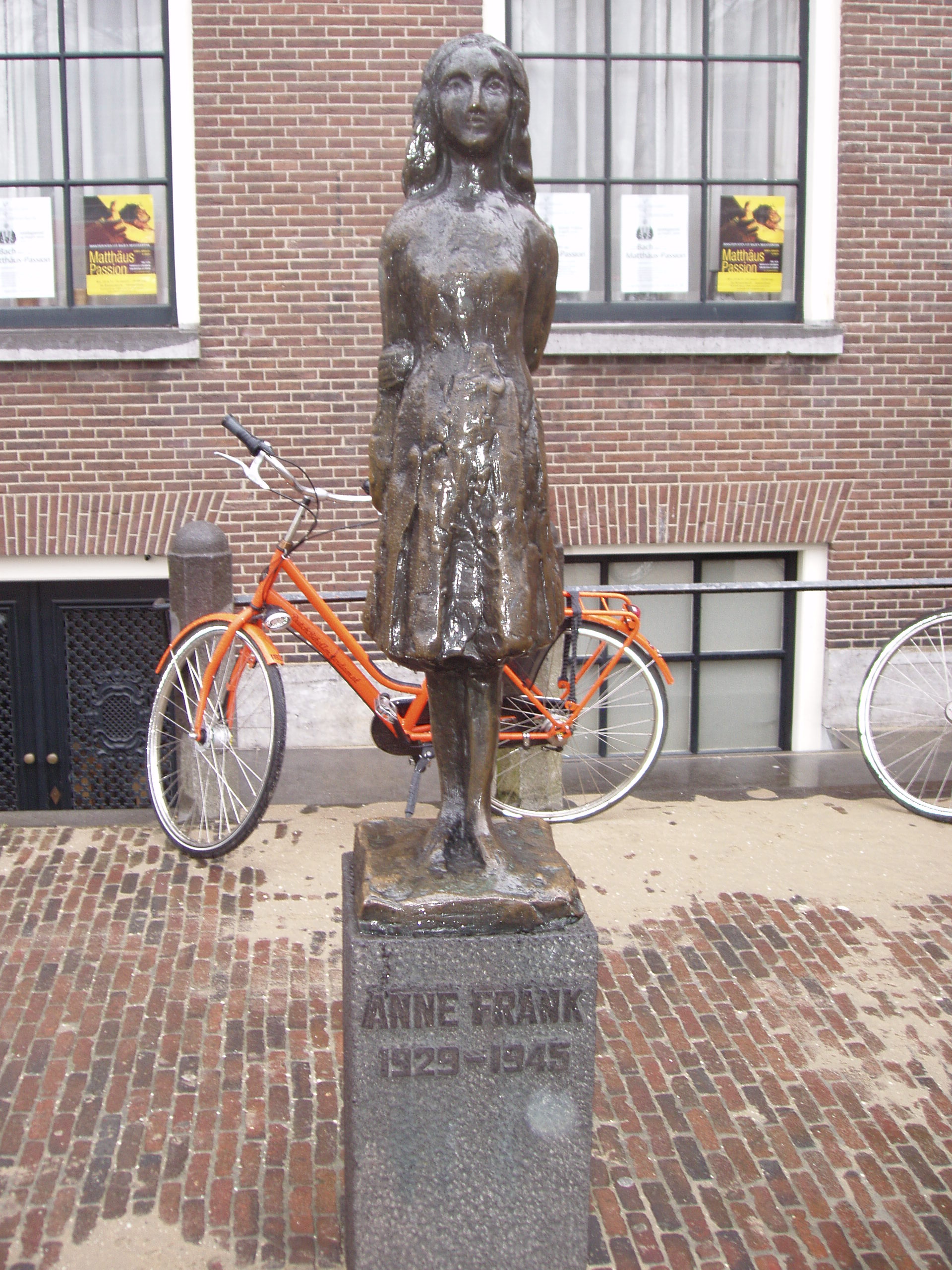
bronze statue of Anne Frank near her house

Anne Frank memorial statue (photo by me)

The Good, The Bad, and The Silly

The Good

Good for Sheriff Dart here in Chicago — he’s suspended enforcing foreclosures (as he did two years ago) until banks can prove they actually have everything in order. Some banks admitted they approved foreclosures without even reading the documents in question. How can you sleep at night knowing you’re making people homeless — and you didn’t even take the time to check if you had the legal right to do so? (Never mind the moral right.)

The Democratic Republic of Congo has one of the highest rates of rape and sexual violence in the world, and this past week, thousands of women there marched against sexual terrorism. Kudos to them for taking a bold stand in a terrifying environment.

I am 100% for finding a cure for breast cancer, just like everyone else. But this Breast Cancer Awareness Month, let’s all be a little more aware of just how dangerously corporate and anti-research the whole pink products campaign is. All that stuff you buy that’s colored pink “for breast cancer”? Half of it may be part of the environmental causes of breast cancer that aren’t getting researched, lest corporate research funders get upset. The fantastic Barbara Ehrenreich was all over this back in 2001 (it’s a really good read).

The Bad

Since when do bodyguards get to handcuff people, let alone reporters entering a public event on public property? The Anchorage DA had sure as hell better prosecute. This is your Tea Party, America.

“We’re becoming a plutocracy” — and no one in America believes it. (Via Shakesville, but I can’t find the exact link, sorry)

The FBI spied on an Arab American student for months (by GPS tracking his car without a warrant, which is now somehow legal), but they didn’t find anything. Too bad he did! He found the GPS tracker and now the FBI wants it back because it’s so pricey.

The Silly

The best blind job application ever, from Mr. Hunter S. Thompson. This is how I’m applying to all jobs from now on.

A girl wrote Johnny Depp and asked him to teach her and her fellow students how to be pirates so they could mutiny against their teachers, and he showed up to do just that.

New Centerstage Review Up

I recommend this play: Too Much Memory by the SiNNERMAN collective.

Parts of it are really hard to watch, but in a good way. Parts of the script are really infuriating, which I addressed in the review. But overall, it’s an intense experience well worth the trip to Rogers Park.

SiNNERMAN’s production of Keith Reddin and Meg Gibson’s “Too Much Memory” adapts and updates the tragedy of Antigone with a sharp cast and taut direction. We learn right away what we’re going to see here: It is political and difficult, and it is all the more important for being both of those things.

Read the rest of the review here. Get ticket info here.

The Headley Surprise: Before Sunrise

Ladies and gents, it’s time for that occasionally recurring Stowaway feature — The Headley Surprise! Today we welcome Julie Delpy and her Before Sunrise character Celine to the canon, and I tell you, I was so pleased with her. In Richard Linklater’s Before Sunrise, French college student Celine (Julie Delpy) meets American post-grad Jesse (Ethan Hawke) on the train from Budapest, and soon they’re disembarking in Vienna and spending the whole night talking, kissing, and watching the morning arrive, before parting ways with promises to meet again in six months. This movie is 15 years old, so I knew the basic story before ever putting it in my Netflix queue, but the execution of that story was more beautiful than I’d expected.

julie delpy before sunrise looks at Ethan Hawke in the train

Julie Delpy, another Headley Surprise

Linklater’s favorite technique is to take a movie consisting entirely of long monologues and philosophical debates, shoot it in an interesting locale or format, and hope that the speeches are good enough to carry the plotless film. (This strategy even mostly worked in Waking Life.) In Before Sunrise, it works magnificently, due in no small part to the magnetic performance of Delpy, who is instantly likeable and entirely believable as a young woman trying to figure out how to move away from her loving parents into a life of her own.

Before Sunrise is often described as a romantic comedy, although it’s more of a straight romance. Either way, Celine defies genre convention. If this were a normal romantic comedy of the last thirty years, Celine would be desperate for a man, but too uptight to get one (in adult rom coms) OR she’d be too strange or superficially unattractive and in need of a makeover in order to realize she wants a man and can win one (in teen rom coms).

Some of it is a function of the age of the characters; in adult rom coms, it is all about MARRIAGE and BABIES and THAT BLAND POTTERY BARN FURNITURE SET THAT PROVES OUR ETERNAL LOVE,

The Proposal Sandra Bullock

"I am telling you for the last time, I have a very busy career -- oh all right, if you're going to insult me like that, I give in. Kisses!"

and in teen rom coms, it is all about POPULARITY and DEFLOWERING and ADMITTING THAT NO MATTER HOW SMART YOU ARE, WHAT YOU REALLY WANT IS A HOT GUY TO LOOK AT YOU TWICE.

Rachel Leigh Cook in She's All That wears glasses

"Wait, did you just glance my way? I never thought to brush my hair before now! All my artistic dreams seem silly compared to being your prom date!"

Celine is in her last year of university at the Sorbonne,  so she’s in that particular place of in-betweenness and uncertainty, as you start to realize that you are not as worldly as you thought you were at age eighteen, and that actually the world is kind of terrifying if you have to navigate it totally on your own. She’s not in any popularity contests anymore, and people haven’t started asking when she’s going to settle down yet.

Ages 21-24 are pretty scary territory to navigate, but they’re also a time of great freedom in Western society, when it’s ok to not be just like everyone else. You were expected to toe the party line in high school, and you’d better start cultivating domesticity soon, but for right now, you can try other things, maybe even see who you are without all those expectations. So age is definitely a factor.

But Celine could still be desperate for Jesse to find her attractive and do whatever he liked to get that attention. She could find herself in a dangerous situation with this strange man and be told she asked for it by not being more careful. She could laugh at all his jokes and agree with whatever he said so as not to appear too smart or threatening. But she does none of these things (ok, she does laugh at his jokes, but fair enough, she seems quick to laugh in general). She has her own opinions and she states them. She is comfortable in her own skin and doesn’t seem at all concerned by wearing her rumpled traveling clothes while flirting with Jesse. Here’s the other factor – she’s no Manic Pixie Dream Girl (damn Nathan Rabin for coining a term I’ve been trying to define for years).

MPDGs are women with childlike interests and worldviews who spontaneously attach themselves to the mopey hero of the tale, who is in serious need of some life-altering sex and full-fledged adoration from a woman with no discernible personality other than “quirky helpmeet.” (See Garden State, Along Came Polly, half the cast of Love Actually.) MPDGs are usually assigned to comedies, but they can be found in dramas and romances, too, especially in death dramas like (Sweet November, Love Story, etc.).  Jesse is clearly a mopey man in need of some life altering, but Celine doesn’t exist just for that purpose; you can see the story equally as that of an energetic woman in need of some conversation and life affirmation. (Hint: if you can switch the focus of the story fairly easily from one major character to another, you have two fully developed characters.)

Celine and Jesse do eventually have sex, but not until two important things are said: 1) Celine goes back and forth a bit on the issue, but not as a tease; she’s genuinely trying to figure out if this will ruin or perfect a lovely night. She expresses her concerns to Jesse, saying something along the lines of, “I think I wanted to sleep with you as soon as we got off the train, but now I don’t know.” She tells him she doesn’t want to sleep with him just so he can go home and brag to all his buddies about banging a French girl in Europe. 2) Jesse responds by saying that it’s not that important that they have sex, and even though he clearly really wants to, there’s no implication that he thinks she’s a frigid bitch for not doing it, and it’s clear that she is a person he cares about and so she wouldn’t just become bragging rights.

How often do we hear these kinds of conversations take place in the movies? These are real concerns in the real world, and they have a lot of dramatic potential, too, from an artistic perspective. They humanize the characters so much, and when they do start kissing and roll over into the dark to begin undressing, it is sexy and sweet at the same time, and not a boring inevitability or titillating display.

julie and ethan stare deeply into one another's eyes

Oh yeah, they totally do it later

A palm reader appears at one point and tells Celine that she will grow into a great woman. She then gestures to Jesse and says “he’s learning,” which Jesse finds insulting, as if he doesn’t matter, but it’s true that his outlook is much less mature than Celine’s. We get no sense that Celine is settling, though, when she spends the night with him. She’s figuring out what she wants in life, and for this night, she wanted him. There’s no slut-shaming and she didn’t do what he wanted to do without regard for her own wishes. She really is growing into a great woman, and this lovely film captures one of the days on that journey.

Of course, there’s a sequel (Before Sunset), and I’m apprehensive about seeing it, but probably I will. I hope Linklater keeps Celine’s intelligence and independence, because these really made her a terrific Headley Surprise.

**********************************************************************************

Post Script:

Another Richard Linklater film that really surprises me with its occasional tip of the hat to strong women characters is Dazed and Confused. In his best-known work, the Parker Posey character is the female version of the Ben Affleck character; both of them take gender roles at their crudest and harshest and make those their rules to live by, which, if not easy to watch, is interesting to see portrayed. And the movie has other teenage girls with their own personalities, thoughts, and dreams; maybe not as many as the boys, since they’re not the main focus, but they’re not all relegated to being just props, either. (Some are – the sophomore who spends the night with the freshman, among others.)  Sure, the boys talk about them the ways teenage boys talk about girls, as sexual conquests to be made, T&A to check out, and girlfriends to be avoided. But we get to see the girls as themselves, by themselves, too, whether it’s having feminist lite conversations about the gender politics of Gilligan’s Island or worrying over whether other girls like them.

I find the movie as a whole too unpleasant to watch anymore, with its relentless focus on vicious “initiation” scenes that are cast in the same nostalgic glow as the pool hall or the Aerosmith concert, but the last time I watched it, I was struck by how many of the female characters were as fully realized as the male characters.
The Good, The Bad, and The Silly

The Good

Elizabeth Goodyear outlived all her family and friends, but in the last seven years she made more, a host of twentysomethings who read to her and brought her chocolates. Hurrah for the human spirit and community! (Via.)

Renee Martin talks about the many ways in which this photo of a young Muslim woman in New York is beautiful.

Here is a helpful way to think about tax brackets, which really matters when we talk about tax breaks and who is affected.

The Bad

Senator DeMint of South Carolina outright says what a lot of people seem to believe (judging by their voting records): Gay people and unmarried women living in sin shouldn’t be teachers. Think of the children, etc. Dear lord.

Sady Doyle breaks down a loathsome editorial. I like her point about “I might be a jerk but” being an opener to a despicable comment that you can’t argue with, because hey, he already admitted he’s a jerk; no need to rub it in! It’s kind of like how “no offense, but” always precedes something really offensive.

Greg Sargent explains to the White House why all their moaning about the left’s “whining” is not only unhelpful but inaccurate besides.

US Border Patrol agents are charged with rape and assault of undocumented immigrants. I like poster Cara’s question: “How can we expect Border Patrol agents to reasonably respect the human rights of undocumented (or even suspected undocumented) immigrants when the denial of their humanity is the name of the game?”

For anyone who thinks we can always trust law enforcement to pursue justice, read this article about how BIA agents lied, saying they’d caught a serial rapist when they knew they hadn’t. It’s not just your department budget or reputation that suffers when you don’t genuinely close a case, it’s the women who  men continue to rape.

The Silly

My favorite part of this photo is that it is the same pose teenage girls use at the beach. Check out the whole slideshow of the European Beard And Moustache Championship.

Another slideshow — this one of some delightful gender-bending.

How do you improve that slightly blurry vacation shot of you and your friends at the bar? Stick in an explosion and some fire with the Bayifier (playing on the explosiosity of Michael Bay films)! My Christmas party just got even better:


me and friends singing Christmas carols with explosions and fighter jets

Wishing you a Very Michael Bay Xmas


The Good, The Bad, and The Silly

I’m off work today and on a library computer (damn AT&T is taking forever to set up at my house), so it’s a short one this week. Feel free to post more in the comments!

The Good:

Kartina Richardson, a great film critic, uses Boardwalk Empire as a great example of how to tackle race in historical art. Mad Men, you’ve run out of excuses. (Ms. Richardson blogs at http://mirrorfilm.org.)

A California judge imposed a ban on “don’t ask, don’t tell.”

The Bad:

Oh but Obama didn’t mean it, apparently, when he said he was for ending “don’t ask, don’t tell,” because he’s ok with the Justice Department challenging Judge Philips’ ban.

Glenn Greenwald, bless ‘im, takes on Andrew Sullivan’s absurd defense of widespread, secret, and presidentially approved assassinations. Do people really want to live on the show 24? (Via.)

And of course there has been a lot in the past few weeks about this sudden increase in children and teens committing suicide after being bullied, specifically being bullied for being gay or being perceived as gay. I don’t know that it’s an actual increase so much as people are paying a little more attention, but regardless, we need to be paying attention. We need to have strong anti-bullying policies that actually get enacted. We need to reject this BS notion that teachers can have a “neutral” stance on whether kids can torment one another — there is no neutral stance when kids are in danger. We need to stop teaching kids that hate is ok.

The Silly

Sessily sent me the link to this great flowchart of female tropes in movies/TV. Tell me someone who doesn’t fit on here!

Guest Post: Running Down a Dream

I warned today’s guest poster, Ms. Sara OD, that if she did not give me a title for her post, I would make one up for her. As you can see, she did not give me a title, so we’re going with a Tom Petty song that does relate to the post but in a kind of cheesy way. Ah well!

I am pleased to introduce you to Ms. Sara OD, a veteran traveler and academic. She has lived in Germany and driven around Australia, and one time we hung out with some swans in Ontario. She holds a Bachelor’s in Philosophy and Psychology, with a Master’s in Religious Studies, and she is working on a Master’s in Library Science. So if you feel the urge to travel, she can find you reference books on where to go, while pondering the larger questions of why you might pursue such a quest and how that relates to your childhood, all with a delightfully understated sense of humor. Obviously, she comes highly recommended. Please enjoy her first post with us here at Stowaway, and be sure to show your affection/ask your questions/request wallaby pictures in the comments.

Running Down a Dream by Ms. Sara OD

The other day I was talking to a coworker about travel and he said something along the following lines: “A lot of people travel to find themselves, but it always seems to me more like running away.” At the time I think I nodded and let this comment slide, intent on going back to making lattes and omelets. But it didn’t sit well with me throughout the day (the comment, not the omelet).

As an avid believer in the transformative power of travel it shook me to think that maybe it was all a sham. It was like being told there was no Santa Claus by Janelle Morris in 1st grade the week before Christmas (this may or may not have actually happened… and Janelle Morris may or may not be a jerkface). I began to ponder the possibility that all the hype about “expanding one’s horizons” and “absorbing new cultures” and “eating stinky foreign cheeses” was actually a cover-up for our inability to tolerate a humdrum existence. Is travel really just a form of escapism? Are we using geographic variation and cultural discontinuity as an unguent for our overworked, understimulated souls? After looking up the word “unguent” I came to a conclusion: My coworker is an idiot.

Although no one would deny that part of the appeal of travel is “getting away from it all,” it also allows for some serious self-discovery. I’m not saying that every time you visit your cousin in Toledo you’re going to re-envision your place in the universe. Nor am I saying that, ala Julia Roberts in Eat, Pray, Love, we ought to romanticize the unfamiliar to the point of saccharine-induced nausea. What I am saying is that when we open ourselves up to certain experiences, certain fears even, we reveal bits of ourselves that would otherwise remain dormant. For me, fear is essential to travel. When we travel, we intentionally displace ourselves, both spatially and culturally. I imagine the thrill of travel is closely related to the thrill of watching horror movies. How much discomfort can I handle? How far can I push myself? How many more stinky foreign cheeses can I eat?

a wedge of Stilton cheese

the stinkiest of cheeses this side of France -- Stilton (photo from http://www.recipetips.com)

The semester I spent in Germany during a study abroad my senior year of college was one of the loneliest and most revealing times of my life. Although my language skills were advanced enough to allow me to competently order a sandwich, this surprisingly did not facilitate an effortless transition into German society. There was always a tangible otherness about me as I fumbled through the different arenas of German life. Everyday tasks became streaked with uncertainty. And to this day I don’t know why it’s necessary that German laundry machines have so many options.

About two weeks into the program there was a day that, like any other day, I was watching dubbed episodes of The Cosby Show. (Until you’ve heard Bill Cosby speak German, you don’t know the meaning of the word “disconnect.”) I decided I’d had enough of Huxtable family values and determined that this particular day was a day of significance. There was an unidentifiable weight to it. Although still not adept at public transportation, I stuffed my German dictionary into my backpack and headed off toward the train station with no idea of where I intended to end up. I don’t distinctly remember that walk to the station, but I do remember the overwhelming buzz of freedom. I remember embracing my solitude. I remember the abandonment of fear. I remember that I should have worn more supportive shoes. Our story ends rather lamely with our heroine going to see a movie in Hamburg (a mere 30-minute train ride away). This is a particularly lame ending given that the movie was The Hitchhiker’s Guide to the Galaxy. But poor adaptations of awesome books aside, the point is not that I wasted twelve perfectly good Euros, but that I reached deep down inside to waste those Euros. Going to see a movie stateside would in no way have tested me in the same way that going to see a movie in Germany did. Eventually I ventured beyond the movie theaters of Hamburg, but that experience will always stick out in my mind as the day I recognized something in myself that, until that point, had been obscured. Only once I experienced that sense of displacement was I able to find the requisite verve to see a truly terrible movie.

University of Hamburg campus from the river

Hamburg, Germany -- not a bad place to see a bad movie (photo from http://www.informatik.uni-hamburg.de)

I know our dear Lisa has discussed many of these themes before much more eloquently than I have done here. I know she has talked about the fear, the solitude, and the sense of self that travel instills in the serious traveler. And what it comes down to is not a cliché about “overcoming fear” or “becoming who you were meant to be,” but a real moment of the self confronting the self. So travelers, know that you are not running away — or at least not only running away — you are also running toward. Toward what is up to you.

New Centerstage Review Up

I saw Candide at The Goodman Theatre, which is a very fancy and fine theater that actually employs equity actors (a novel thought to me, when just about every play I see is entirely volunteer-based — would that all actors could be paid!). I enjoyed the show and recommend it if you have the cash. An excerpt:

Voltaire understood that the best way to get at the fundamental questions of life is to show just how absurd life is. The Goodman’s production of Leonard Bernstein’s musical adaptation of “Candide,” helmed by director Mary Zimmerman, perfectly captures this spirit.

Read the rest of the review here.

Also, if you know of any plays coming up that you think I should review, let me know, and I will see if I can snag it for my editor.